Because we are such a forward thinking, progressive, and compassionate organization, we here at Lucas-Murray-Music are giving our talented, hard-working, and handsome staff a much needed day off in order to rest and recharge during an emotional holiday season. In lieu of a blog-post, please pour yourself a glass of Merlot and enjoy this video of the top 100 Vince Carter Dunks. Or if you prefer just skip to here and watch the two whitest men in NBA history halfheartedly try to thwart the greatest dunker of all time. OR, if you insist on this still being a music blog, just scroll past Vince (don’t really scroll past Vince though), and watch the greatest band of all time performing on top of somebody’s roof.

Seriously, when I’m old and telling my grandchildren stories of the glorious past, at least three of those stories will be about Vince Carter dunks.

And now this:


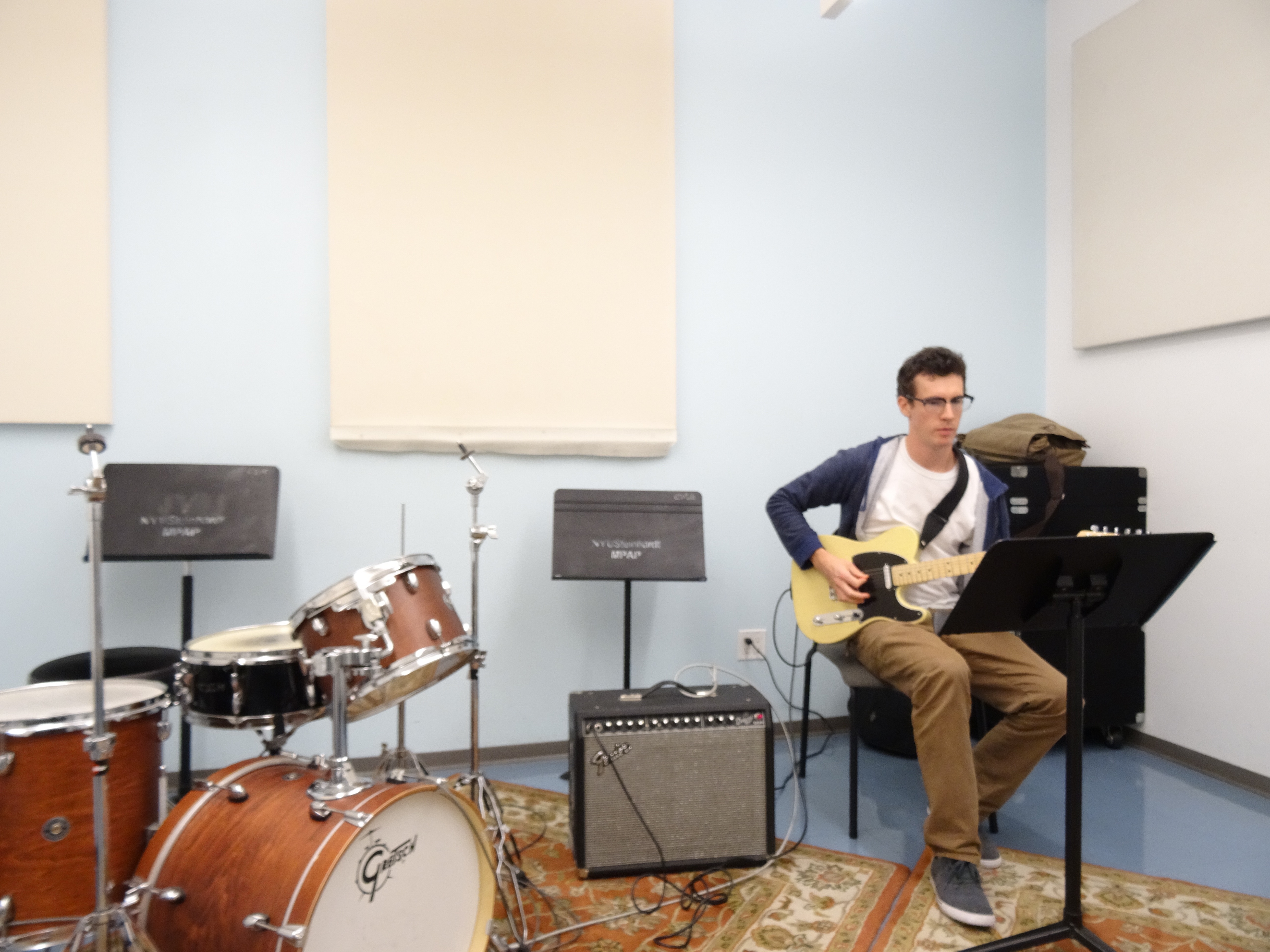
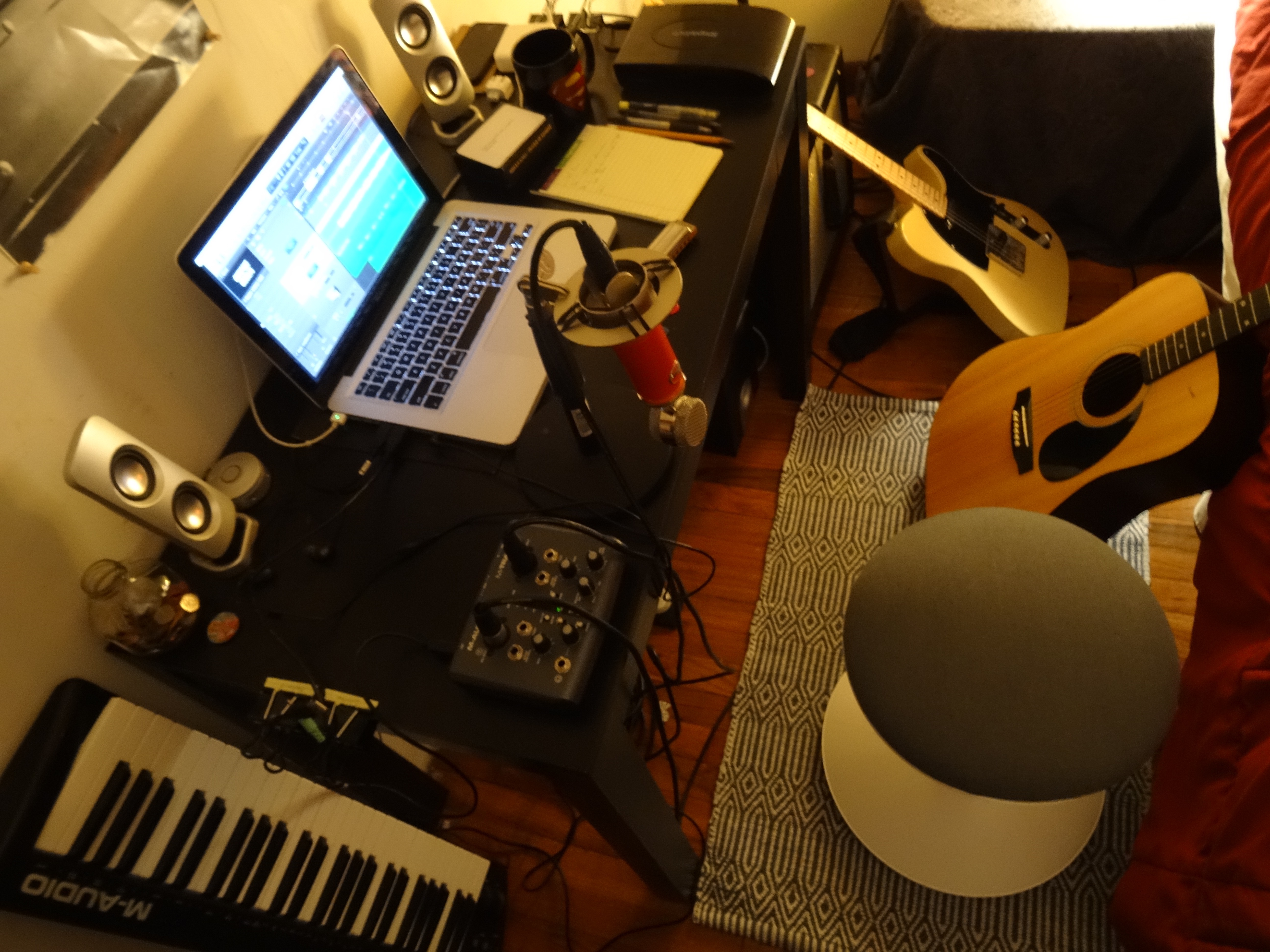
World's Smallest Studio
World’s Smallest Studio

Before arriving in New York City I was excited about the prospect of turning over a new leaf in such a lively place. I was convinced that I was going to work harder than I ever had before— I would write, record, play gigs, excel in school and promote myself ceaselessly. For I knew that if I did these things that I would grow musically, enhance my career, meet some incredible people, and learn countless lessons that I would carry with me for the rest of my life. Yet as anyone who has ever set a new year’s resolution knows, it feels great to dream up a grand new life, and it feels bad when you inevitably fall short of your goals. Thus, I was feeling blue last week because (in addition to America electing it’s first cartoon super-villain president) I felt like I was falling short of my musical and personal goals for my time in NYC. Sure, I’ve been going to school, doing my work, and paying my bills— there’s no reason for anyone else to be upset with my behavior here, and yet I am disappointed in myself because I know in my heart that if I truly want to succeed in music here or anywhere else, there is much more that I could be doing. So I did what I always do when I’m feeling down on myself: I made a list of things that I could do to make myself feel better.

1. Seek out gigs. Why? Because performing has been such a large and positive part of my life for the past nine years and I’m sad to say that I haven’t played a single gig since I’ve been here. I yearn to perform, and I absolutely have to if I want to become a part of the New York City musical community.

2. Talk to David Schroeder, the director of the NYU jazz studies department. Why? Because I’ve had something on my chest since I enrolled in school here—namely that I do not think that I am a “jazz musician.” I absolutely love learning from the many jazz masters who teach at NYU, but I needed to bring it to light that I am interested in playing a great many other genres and that it is likely that I am not going to make my millions (or thousands, or dozens) strictly playing jazz.

3. Play music with someone. Why? Because I’ve been spending far too much time cooped up in a small room practicing music, and not enough time actually making music with other people. As I’ve written before, playing music alone and never doing it with others is merely masturbation.

4. Call the producer of a short film that I am scoring. Why? Because I wanted to clarify some of our goals and deadlines, and it is better for me to be proactive than to passively wait on her guidance.

5. Go play pickup basketball. Why? Because I love pickup basketball. It’s fun, therapeutic, social, and there’s no better sound than a crisp swish.

I am very proud to say that in addition to fulfilling my usual school duties, I achieved all five of these goals this week. I booked a couple of gigs for mid-December, I had a wonderful heart to heart with David Schroeder, I played music with a couple of classmates, I got in touch with the producer, and I played pickup basketball. Each achievement momentarily infused me with joy and confidence and yet, on Friday after I had accomplished all of them, overall I still felt low. The good news is that I’ve lived long enough to learn that sometimes my sadness is not a result of outer circumstances, but just part of the natural ebb and flow of my spirit. You cannot have happiness without experiencing sadness, and I’m likely experiencing a natural low after the incredibly exciting high of being a New York City newcomer. I’m oddly at peace with my sadness, for I know it will pass and give way to joy again. Such is life.

So Friday night I was feeling sleepy and sad as I was taking the Subway home—I got off of the A train in order to transfer to the C, when I was suddenly face to face with a vivacious young subway performer wearing a red tie prancing around singing Holly Jolly Christmas along to a backing track. Now I’m generally uninspired by the song Holly Jolly Christmas (especially before Thanksgiving), but there was just something so enjoyable about watching this little dude sing it. He followed up Holly Jolly with his final number of the evening: a highly dramatic dance routine to a high-energy club song. It is comical for me to write this, but I sincerely mean it— that little guy’s sparkling dance routine brought me back to life. I felt intense joy at watching him so freely and spontaneously express himself. Coincidentally, if you go to his instagram page (@masterblasterg) you can actually see video of this exact moment. Scroll down to the video titled “Dance because you can” and you’ll see me in the background, first languidly looking at whatever distraction I have pulled up on my phone, and then by the end, flashing a huge grin.

As he was packing up his gear I went over to slip him a tip and talk to him. His name is Gabriel Angelo and he is 17 years, and he had the same effervescent personality in conversation that he does while performing. I asked him what his musical goals are, and he told me (with a dramatic wave of his hands) that he wants to do more shows than anyone ever has in the world, and to heal people with his music. You’ll have to suspend your cynicism to read this (as I have to suspend mine to write it) but he did heal me that night. I cannot describe it any other way than to say that in watching him sing and dance, he transmitted his pure joy directly to my heart and soul. As if that gift was not enough, he reminded me that I did not fall in love with music for any practical purposes. I fell in love with music because of it’s mystic ability to transmit feelings beyond words. Certainly it is good to set goals for myself and achieve them, but I should remember that practical goals may have very little to do with love, happiness, and music.


img_0053

I said to myself, “I am thoroughly happy and content, now. If my most pitiless enemy could appear before me at this moment, I would freely right any wrong I may have done him.”

Straightaway the door opened, and a shriveled, shabby dwarf entered. He was not more than two feet high. He seemed to be about forty years old. Every feature and inch of him was a trifle out of shape; and so, while one could not put his finger upon any particular part and say, “This is a conspicuous deformity,” the spectator perceived that this little person was a deformity as a whole. A vague, general, evenly-blended, nicely-adjusted deformity. There was a fox-like cunning in the face and the sharp little eyes, and also alertness and malice. One thing about him struck me forcibly, and most unpleasantly: he was covered all over with a fuzzy, greenish mold, such as one sometimes sees upon mildewed bread. The sight of it was nauseating.

The above is an abridged passage from Mark Twain’s 1876 short story “The Facts Concerning the Recent Carnival of Crime in Connecticut,” and the sense of disgust that the protagonist feels at this fuzzy little troll-person very accurately sums up my feelings right now about president-elect Donald Trump. I borrowed Twain’s description because I, in fact, cannot accurately convey with my own words the deep visceral disappointment that I am feeling about the election results. The closest I can come to expressing it with my own faculties is by making pained guttural noises (not unlike what I imagine an aardvark dying would sound like).

I, and nearly all of my friends, family, and Facebook feed are feeling shocked, outraged, and afraid at the prospect of Donald Trump being our next president. It is tempting (and quite enjoyable in fact) to sit back and fire insults at Trump and his supporters. Like this: Trump and his supporters are the human embodiment of a Nickleback song— tasteless, gross, loud, and limp. Yep, that felt good. I could do that all day. Yes it is tempting (and fun), and yet counterproductive. For here is the twist in Twain’s tale: the narrator reveals that the “vile bit of human rubbish seemed to bear a sort of remote and ill-defined resemblance to me!”

Like Twain’s character, we as a nation are now face to face with a clear embodiment of our own twisted nature. I don’t believe that most of Trump’s supporters are overtly racist, misogynistic, or stupid, yet I do know that Trump’s victory has seemingly given license for some of his supporters to partake in some very racist, misogynistic, and stupid behavior. The KKK in North Carolina has announced plans for a Trump victory parade. On Thursday at my own NYU the door to the Muslim Student Association’s prayer room was vandalized with the word “Trump.” On Friday a teacher reported that a ten year old girl had to be picked up from her school because a boy had grabbed the girl’s vagina—when asked why he did it, the boy said “if a president can do it, I can too.” Since the nation’s founding, America, while boasting some truly great cultural, social, economic, and technical achievements, has always harbored an appalling underbelly of racism, sexism, and domination. Because we have elected an appalling, racist, sexist egomaniac to be our president, this underbelly is simply being more blatantly exposed than usual.

If there is any silver-lining to the fact that some people now feel emboldened to play out some of their darkest drives, it is that we as a country can no longer ignore it. Whether in a single person, a family group, or an entire nation, things do not change unless it is first recognized that there is a problem. In my eyes, it is clear that we have huge racial, economic, social, and educational divides in this country, and that those divides breed fear, hatred, and disregard. We cannot simply write this off as the fault of those “ignorant” Trump supporters. If we want America to be great—not “great again,” but for the first time— we all have to accept responsibility for the fear and prejudice in our country and in our own hearts and combat it with love whenever we see it.

I am encouraged by the massive and active backlash against the election of Donald Trump. Right now there is a days long protest roaring at Trump Tower, just a subway ride away from me. Liberals and democrats have been suddenly inspired to action in a way that they would not have been if Hillary had been elected. This is a wake up call. There is a huge amount of energy behind the anti-Trump movement and if everyone who is disappointed in the election results decides to use this energy not towards Trump-hate, but towards acts community building, volunteerism, social justice, and general kindness, then I believe that we can transform Trump’s presidency into a step forward, rather than two steps backwards.

In addition to being inspired towards social action, I also also feel an urgent desire to double down on my musical life after this election. For playing music has been a bridge in my life to communities of people that I would have otherwise not been exposed. I’ve performed with and for people of all different races, cultures, sexual orientations, and political leanings (yes I’ve even been in a band with a Trump supporter or two). It did not matter what our superficial differences were, we were all there to just enjoy the incredible human endeavor of making music.

For it is not politics, but our shared passions (whether music, sports, cooking, dancing, art, science, writing, sewing, etc…) that have always brought people together. In 1999, it didn’t matter if Eminem was white, he was accepted into the historically black Hip-Hop community because he could rap really well. In 1947, it didn’t matter that Jackie Robinson was black, he was accepted into the historically white Brooklyn Dodgers clubhouse because he could play baseball really well. In 1898 it didn’t matter that Marie Curie was a woman, she was accepted into the historically male scientific community because she discovered Radium (and made many other great scientific breakthroughs I don’t claim to understand). Now I admit that Robinson and Curie were “accepted” into those communities with a lot of struggle and backlash, and I need to point out that you shouldn’t have to be superlatively great at something to be accepted into a community. Yet the point that I am trying to make is that it is in fact rarely politicians that affect true social change and progress— the most powerful positive force in the world is normal people coming together to do the things we already love to do.

bptm-morocco

Last week I opened up my blog by boasting about a Tinder date that I went on. I truly meant this only to be an attention grabber before I launched into an exploration of the decline of melody in music. Yet it appears that people were much more intrigued by my date than my musical musings. The overwhelming response to my blog post about the disappearance of melody in music was this: “how was the Tinder date though?” Well much like Fauzio, I aim to please, and so I’m going to indulge your thirst for a vicarious experience of NYC Tinder life and tell you about my date.

I had an incredibly pleasant time with a beautiful young Irish woman who was charming, upbeat, humorous, and delightfully outspoken. Our plan was to meet up at The MoMA, view some art, chat over coffee, and then part ways. Yet after the MoMA we had dinner together, and after dinner we went to a bar, and after the bar we went for a walk, and after the walk we met up with a friend of mine and chatted at a cafe, and after the cafe, we took the subway to my house and watched some Game of Thrones. And no, this was not a “Netflix and chill” kind of situation— get your mind out of the gutter people. It was just wonderful evening filled with really good conversation, laughter, and flirtation.

The truth is I’m not actually telling you all of that because I want to grant you your wish of peaking into my romantic life— (as usual) I have a larger point to make. Believe it or not, me going on that Tinder date, has everything to do with me fighting for the presence of melody in music. That’s right fools! I’m not abandoning my discussion of the decline of melody in music. Stay with me now…

What is melody? The technical definition of melody (per dictionary.com) is “The succession of single tones in musical compositions, as distinguished from harmony and rhythm.” But more generally what is melody? It is an active statement; it is the part you can sing; it is the part you remember. If you think of a musical composition as a story, as many composers throughout history have, melody is the dialogue and action that propels the plot. Harmony and Rhythm would be more like the setting and pace of the story. And yet if it is such an important part of the musical story, why then are more and more composers in jazz, film, and popular music abandoning clear melodies?

The simplest answer is that it is easier to not write a melody than to write a melody. While the simplest answer is often the correct one, I believe that there is also something more poisonous at play: on some level most everyone wants to be cool, and at some point melody became uncool. I can express this easier with a musical example. Listen to any or all of both of these pieces of instrumental music: Serenade no. 13 in G Major by Mozart and Lizard Point by Brian Eno. One has a very distinct memorable melody throughout, and the other doesn’t really have a melody. Which do you think is cooler (not better, just cooler)? Because it is much more mysterious and abstract I am going to guess that most people think that the Eno tune is cooler. A melody is a clear statement, and a clear statement is rarely going to be perceived as cooler than something more oblique.

We could think of it like this: a melody is like looking up and saying “I love how the sun beams through the trees in Central Park.” As nice and true as that statement may be, it is simply not as cool as just staring off at the trees, silent and expressionless as you smoke a cigarette. Certainly the latter is cooler, but is it better? No way. First of all, smoking is bad for your health. Secondly, you are not communicating anything to anyone else by staring off into space. You’re just living in your own cool, insular, lonely world. And yet we are all victims under the oppressive tyranny of the cool— nobody wants to be considered uncool, and yet nobody knows exactly what it is to be cool, thus many people simply avoid making statements (verbally or musically) for fear of being uncool.

So what the hell does going on a Tinder date have to do with writing a melody or being cool? Well, on Tinder I’m a perfectly cultivated cool guy. I have pictures of me holding a guitar, laying on a raft with sunglasses on, effortlessly posing with a real live butterfly on my shoulder, and an equally cool “about me” write-up to boot. Given the extra time to think up responses I’m also far more clever and witty in Tinder text message conversation than I am in real life. Thus, I could have contented myself to stay at home and just be a cool idea of a person, but I chose (as did she) to actually go meet up with someone and expose myself as a real, flawed human. In person, you hear my goofy laugh, you witness me fumble with words sometimes, and you sense my subtle nervousness and excitement about being on a date. I’m not as cool in person, but I am much more real— I’m someone you can actually connect to. It doesn’t matter how cool someone is on paper, the only thing that matters in romance is how well you connect with someone face to face, and the only way to do that is to get out of the house, go on a date, and put yourself at risk of being uncool. Thus, the acts of writing a melody and going on a Tinder date are both mini rebellions against the tyranny of the cool.

And even the coolest people can rebel against the tyranny of the cool. My friend Epiphany Morrow (musical artist, rapper, public speaker, philanthropist, and entrepreneur) is by all measures a very cool dude. This week Epiphany released his long awaited Legacy Project. Billed as the world’s first “living album,” The Legacy Project is a smartphone app offering an interactive music and video experience which draws users into a unique world of Piph’s creation. You most certainly should download it (just search “big piph” or “the legacy project” in your app store). Despite the fact that many would undoubtedly consider Epiphany a cool dude, the best part about him is that in The Legacy Project and in so many of his other endeavors he too routinely and unapologetically puts himself at risk of being uncool. For it is not because I think that he is cool that I respect and admire Piph (in fact I know him well enough to know that he is actually a closet-nerd)— no, I respect and admire him because he is incredibly genuine, disciplined, and creates art that has true perspective and substance behind it.

You may not see it, but I do: the acts of going on a date, releasing an app, and writing a melody are all important rebellions against the tyranny of the cool. Certainly nobody wants to be uncool, and yet the only actions or statements that have any meaning or weight behind them are those that do put us at risk of being uncool. And here’s the liberating truth: there is really no such thing as cool. When Miles Davis gave birth to the cool back in 1957— he gave birth to a phantom. Cool is simply a figment of our collective imagination. Love is real, beauty is real, laughter is real, and cool is not real. The sooner we all realize that, the sooner we’ll being to really live.

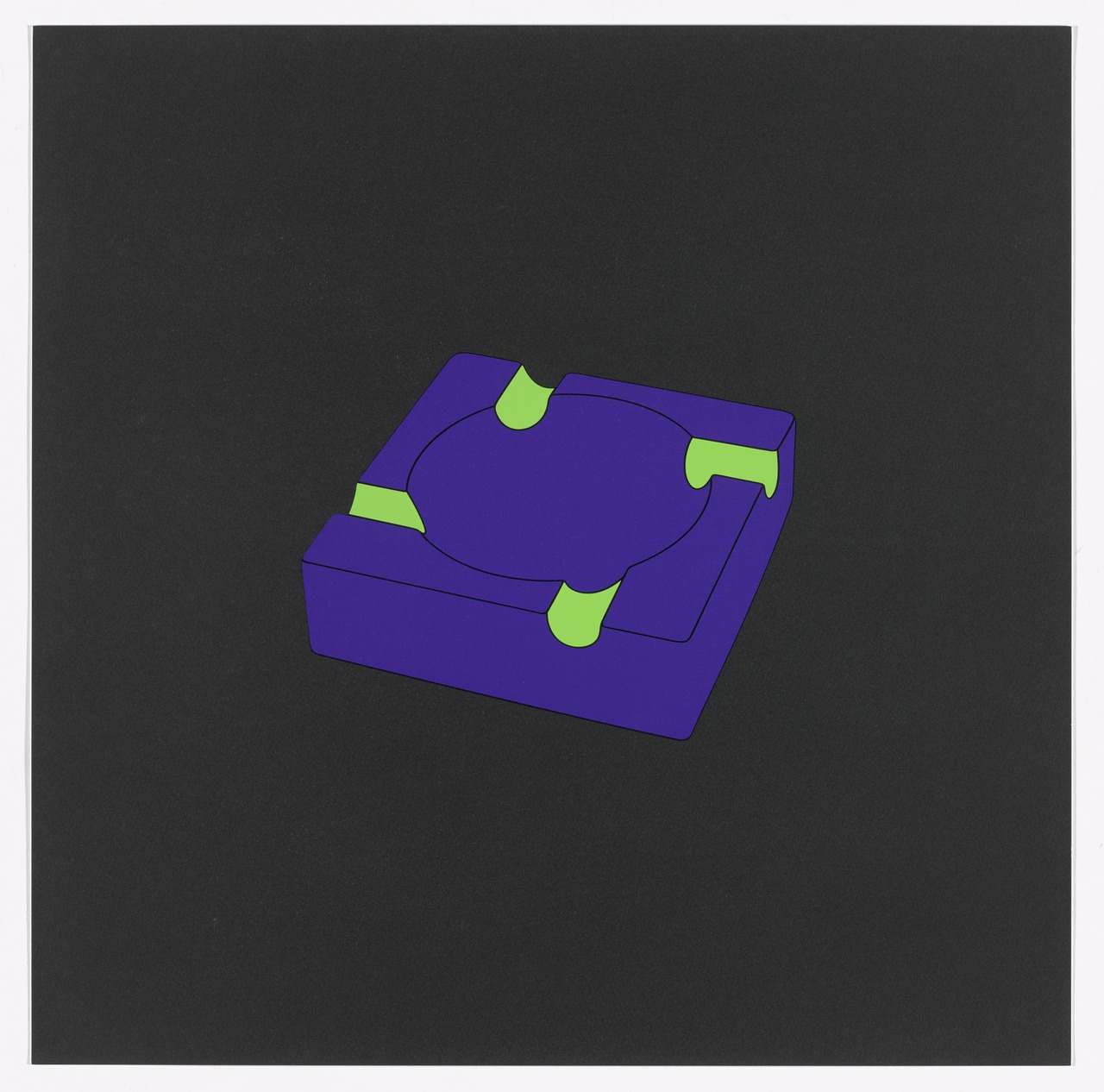
 Ashtray from Alan Cristea Gallery Twentieth Anniversary Portfolio 2015
Ashtray from Alan Cristea Gallery Twentieth Anniversary Portfolio
2015

Yesterday I went on a Tinder date to the Museum of Modern Art. There’s no real reason for me to tell you that I was on a Tinder date except for the fact that I probably just won a few more readers who are titillated by the phrase “Tinder date.” And now, despite the fact that I keep repeating the phrase Tinder date, I’d like to direct your attention more towards my experience of the MoMA and less on the Tinder date. I confess that at the MoMA I felt a lot like how my German friend Dierk feels feels when he watches a Richard Pryor standup comedy special: “I don’t get it!” (please imagine a deep-voiced German man saying that). I could chalk this up to the fact that I am not well-educated and up to date on the trends of modern visual art, but I actually experience this same feeling when listening to some modern musical art (a field in which I’m at least relatively well educated and up to date). The truth is that some art and music is simply more intelligible than other art and music.

For instance, I had a wonderful experience of perfectly intelligible music last Saturday at the legendary Blue Note jazz club. At the classic venue, looked after by a suspender-clad waitstaff, I saw the one and only Bill Frisell play alongside Petra Haden (vocals), Thomas Morgan (bass), and Rudy Royston (drums). With his trademark reverb-laden telecaster tone, Bill and company played arrangements of classic film and television music from their album When You Wish Upon A Star. They put a haunting and spacious twist on classic movie songs like You Only Live Twice, The Windmills of Your Mind, and the theme from Psycho. Yet for all of the unique character that they infused in each song, they never sacrificed clarity for the sake of novelty. I walked back to the subway feeling uplifted, whistling the tunes that I had just heard.

Conversely, on Tuesday night I took a stroll to a new venue called Nublu— this is likely a stretch but I wonder if the phonetic pronunciation of the club (“new blue”) is an intentional nod (or perhaps even a jab) towards the long-standing Blue Note. Nublu, with it’s darkly lit industrial aesthetic, glowing bar, and psychedelic tapestry of light projected onto a large wall, was clearly much more modern than the Blue Note. As I watched the band tune up and prepare to play, I realized that this was one of the most talented collections of musicians I would ever see perform together (Dave Binney-sax, Chris Potter- sax, Adam Rogers- guitar, Matt Brewer- bass, Craig Taborn- keys, and Justin Brown- drums). Between the sleek setting and incredible musicians, I had a giddy sense that this was one of these “only in New York City” kind of moments. And yet after thirty minutes of hearing them play relentless, high energy, complex, and sometimes atonal music, I was ready to leave. There was no doubt of the skill onstage with each performer playing blistering solos— there was simply little for me to latch on to and enjoy. I left with nothing in my head that I wanted to whistle.

“What ever happened to melody!?” This was a question my film scoring instructor Chris Hajian asked me this week in our lesson, and a question I was asking myself after the show at Nublu. For the past couple of decades or so (and probably much longer), whether in jazz, or film scores, or pop music, the importance of melody has undoubtedly waned. For example, what’s the billboard number one song right now? Don’t worry I’ll look it up— ok it’s a song called Closer by the Chainsmokers. Now I just really hate this song already, and I’ve only heard it once, but let’s identify what is important and prominent about this song: the beat, the timbre change from the male vocals to the female vocals, the distinct intentionally lo-fi sound of the synth, and of course the corny, cliché, stupid ass lyrics. It is certainly not the melody that is important. The melodic moments are short, simple, and repetitive— this is certainly not a hit song because of the melody alone. Ok now then what was the number one hit on this day in 1996? Oh no, it was the Macerena! I was hoping to prove that 1996 was more melodic than 2016, but that is not a great example now is it? Ok we better go even further back in time… on this day in 1976 the number one song was Chicago’s If You Leave Me Now. Whether you like this song or not, you’ll have to admit that the melody plays a much more prominent role in it than in most of the hit songs of today. There’s strong contour, momentum, and variation in this melody. Indeed, unlike the song Closer, the main reason that If You Leave Me Now was a hit is because of it’s melody.

And now, straight out of the blue, it’s time for me to stop being pretentious and start getting real. I’m abruptly signing off of this blog post, because I have a laundry list of other things to do including film clips to score, guitar solos to transcribe, and Westworld to watch. But are you still wondering why melody has diminished over time? And do want to know how my Tinder date went? And is this a complete cop out ending the blog post like this? Stay tuned for the thrilling conclusion next week as these and many other questions are finally answered!!


img_1132

Last week I was in a coffee shop struggling to write a blog post about booty, when I started eavesdropping on an amusing conversation. I listened as the shop’s two hipster employees spun a random web of banter (from farmer’s markets to penne pizza to Keurig coffee to that business card scene in American Psycho) and suddenly I had a sad realization: eavesdropping on this conversation was the most interesting thing I’d done all week. I was struggling to write the blog post because I didn’t do anything worth writing about that week— I just went to school, practiced, did my homework, ate food, watched game of thrones, read Harry Potter, and slept. It was a good week— but a boring week to read about, so I was stuck mining my mind for some interesting concepts. But concepts are not interesting— they’re just dead ideas unless you do something with them. So I vowed then and there that the next week I would go out and really do something, because (dammit) I live in the most vibrant city in the world, and (dammit) I need these blog posts to be easier to write. Thus, I’d like to throw out the tired old concepts this week, and just give you a recap of some of the more interesting things I did.

I began my adventures last Friday night by taking a stroll down to Union Square (well known hangout for eccentric characters). I was just eating an apple doing some people watching when I saw a large mass of people circle up and heard someone from the inside suddenly shout “If you’re loving the Cyphers put your fist up, and say hell yeah!” (and naturally all the spectators put their fists up and shouted back “hell yeah!”). I approached the crowd and soon realized that there was a hip-hop beat playing and many people trading freestyle verses over it. Apparently I had walked into a meeting of the Legendary Cyphers, a renowned freestyle session that happens every Friday night in Union Square (read about it here please). Many of the MC’s were wearing Legendary Cyphers shirts, most were just in plain-clothes, and one guy was inexplicably wearing a full Aquaman costume. I learned from their verses that they were honoring an MC called Majesty, one of the founding members of the Legendary Cyphers who had recently passed away. I was captivated by the scene— some of the MC’s were incredibly talented and effortlessly picked up where the previous rapper had left off, then spitting a clever collection of puns, metaphors, and cultural references. Some of the MC’s were clearly amateurs, yet this was obviously a safe, supportive space with the beginners being lifted up by the heavy weight MC’s rather than put down by them. If one rapper began to flounder, there was no dissing or booing—another MC would simply pick up where he or she left off and the cypher would continue. For the roughly hour-long duration that I watched, the rapping never stopped. The beats would change every five minutes or so, yet the MC’s never stopped flowing. As I watched I was constantly aware of the many similarities between this and a jazz jam session, but that is the topic for a future blog post…

The next day I decided to do something I have not done in years: watch an Arkansas Razorback football game. There’s a bar in Times Square called Hurley’s Saloon that hosts watch parties for Razorback sporting events (don’t ask me why). I wanted to go hear some Arkansan accents so I threw on a red shirt and brought my buddy Jonathan along to watch Arkansas get royally stomped by Alabama (coincidentally, Jonathan went to the University of Louisville who is currently having success under the memorably-fired former Razorback coach Bobby Petrino). We sat and drank some beers and I told Jonathan that I wanted to go talk to the people at the table nearby. He seemed doubtful that I would actually cold approach a table full of strangers and introduce myself, but he’s never been to Arkansas and doesn’t understand how small of a world it is there. So I got up and introduced myself to a table of five women (oh maybe it was the “five women” part that made him doubtful), and after some brief small talk I discovered that two of them were indeed in Bible study with my aunt Martha Jane at First Methodist church in Hot Springs, and one of them was an assistant principal at Pine Bluff High School when my friend Epiphany Morrow was a student there. To borrow a term from Malcolm Gladwell, Epiphany and Martha Jane are “connectors.” They both know a lot of people and a lot of different types of people. I’ve been very lucky to have been propped up and helped along my life’s path by a number of friends and family members who are connectors. Because of this, I too aspire to one day be a helpful connector to many people in my life, but that is the topic for a future blog post…

My week at school passed by with plenty of practice and classwork, and by the time Thursday rolled around I was ready for another outing. A fellow guitar student at NYU named Ben recommended I go see the excellent guitarist (and NYU professor) Adam Rogers perform at 55 Bar with his power-trio Dice. Rogers is mostly known as an accomplished jazz guitarist, but in this band he breaks out a Fender Stratocaster and fully flexes his rock muscle. He still played with his trademark technical skill and advanced harmonic and rhythmic ideas, yet he did so in the context of arrangements of songs by Sam Cooke, Bobby Womack, and Jimi Hendrix, as well as some heavy-hitting originals tunes. It was fun and invigorating to see such a great performance, yet watching Rogers play this style of music was inspiring on another level as well. For I imagine that the current generation of jazz guitarists did not first pick up a guitar because they heard a Kenny Burrell or Wes Montgomery album. They were probably first inspired by rock gods like Jimi Hendrix or Jimmy Page and only later seduced by the deep well of musical ideas that the jazz cats provided. Thus, it was great to see present-day Adam Rogers playing something that I imagine a 13 year old Adam Rogers would have enjoyed— certainly my 13 year old self would have enjoyed it, but that is the topic for a future blog post…

I keep harping on this phrase “the topic of a future blog post” to show that simply by going out into the world and doing something (anything really), I have gained, if I want to use them, ideas for at least three new blog-posts as well as concrete experiences to support them. Whereas last week I spent hours upon hours struggling to write a purely conceptual post, this week’s post flowed easily from the pen to the page (and then from the fingers to the screen as I typed it up). Yet because I’m a conceptual kind of guy and I can’t stay away from abstract ideas for too long, I’d like to leave you with what I think is the underlying lesson of this week’s post: The more that you do, the more you that you can do. The more you practice your craft, the more gigs you’ll be able to handle; the more people you go out and meet and invest yourself in, the more people you’ll have to help you in your personal and professional life; and the more you just get out of the house, the more you’ll have to talk about in your music blog. See you next week!

In the immortal words of Q-Tip, “Question: what is it that everybody has, and some pirates and thieves try to take? … Da Booty.” The booty is a natural place to start if we want to talk about music, because one basic function of music is to make you move your ass. It’s liberating to shake your ass after all. Go ahead and try. No one is watching (and if they are, even better). Stand up and shake your butt right now.

Few of you did. I understand, it’s a little embarrassing if people are watching, and if there’s no music playing then you’d probably feel a little bit crazy. It’s much more natural to shake your groove thing if you have a funky beat on hand— for me it even feels unnatural to stay stationary if there is an infectious groove within earshot. This is indeed one great power of music. It compels us to do something incredibly enjoyable that in silence feels awkward and forced. If you haven’t yet let music move your backside, I implore you, the next time you’re alone, put on some James Brown and shake that thing. You’ll be a better person afterwards.

I love music that makes me want to physically move, and a lot of music is written solely for that purpose. Most dance songs (whether disco, funk, electronic, or anything else) are basically telling us to turn off our brains and turn on our butts (the body’s natural center of dance). Yet in studying Jazz here at NYU, I’ve basically had to park my butt in a chair and turn on my brain. For at this point, the only way I can fathom something like playing an altered dominant scale in a 5/4 time signature is to think about it. I’ve got to use my brain for something like that because if I asked my butt how to do it she would just say “man, why not just play in 4/4? That way you can clap on beats two and four! And a what scale? Just play a C chord for a while and then maybe go to that A minor chord… come on it’ll be fun!”

Jazz, more than most other genres, has offered a haven for people who wish to take a cerebral approach to music. I’m not ready to say that this is the only way to approach Jazz, but the very fact that you can get a PhD in jazz studies indicates that there is great intellectual depth to the music, and that using your brain to wrestle with that depth is a worthwhile endeavor for the student of jazz. “Wrestling” is indeed a good way to describe my interaction with the music at the moment. For the past month I’ve been consistently exposed to some of the best musicians I’ve ever heard, making me realize more than ever how little I know. It is a challenge, but I know that the only way that I can begin to climb the ever growing mountain of musical knowledge that I see before me is to use my head. My butt is not going to get me up that mountain— instead I have to use my brain to do the hard work of analyzing tunes, memorizing melodies, experimenting with new harmonies, perfecting difficult rhythms, and much more.

Yet between the brain and the butt, there is another part of the body that has something important to say about music: the heart. The philosopher Herbert Spencer once said that “music is the language of emotion,” and lately I’ve been directly interacting with this idea in my film scoring class. Certainly there are many functions of music in film— in class we came up with a list of about 25— but one of the most basic functions is to convey the emotional tone of the moment in order to make the story being told much more vivid. What, for instance, is the movie The Graduate (one of my all time favorite films) without the brooding sense of aimlessness evoked by Simon and Garfunkel’s The Sound of Silence?— probably still a good movie, but not the memorable masterpiece we know it to be.Great film music tells the story alongside the action onscreen, pinpointing the mood of the scene and communicating it directly to the heart of the viewer. Thus, learning (or struggling might be more accurate)to write film music has been for me a lesson in understanding music’s emotional power.

Last Saturday I went to Smalls Jazz Club (it is indeed, very small) to see the group Jean Michel Pilc and Total Madness (Pilc on piano, Ari Hoenig on drums, Joel Frahm on Tenor Sax, Chet Doxas also on Tenor, and Francois Moutin on bass), and I don’t think I have ever seen a group so expertly capable of expressing music in the three ways that I’ve mentioned above. Throughout the night they were intellectually stimulating, combining advanced harmonies with rare time signatures at blistering speeds. They were also incredibly emotive in their playing— you could feel the emotional weight of their notes instead of abstractly admiring the fact that they were playing them. And perhaps most remarkably, they sometimes made you want to dance— despite the fact that they were often playing in time signatures that my brain could not immediately follow, they played with such rhythmic accuracy and a sense of the groove that if I were a braver and slightly more obnoxious man, I would have busted a move in that tiny jazz club.

Not every musician will reach the height of Jean Michel Pilc and total madness. It is a fine achievement to just write really good dance music, or intellectually challenging music, or emotionally expressive music. But know that music does not serve a single master. Music is a multiplicity that can speak to your brain, your heart, or your butt, and I aspire to let it speak to all of me.


dsc00490

Watching the presidential debate last Monday was similar to what it would be like to watch the mighty German national soccer team play a match against the tiny nation of Belize* if all the Belizean players were drunk and high on cocaine. Imagine: Germany is far and away the better team, relentlessly and smugly scoring goal after goal after goal on Belize, yet the intoxicated Belizean players refuse to recognize any of the goals scored on them. Belize stubbornly pretends they’re tied and that its an even match. They celebrate furiously every-time they administer a violent slide tackle or use their hands and try to throw the ball in the goal. Also the referee is Lester Holt, and he obviously has no control over this shit-show of a match.

Now I’m not suggesting that Hillary is as precision perfect at debating as Germany is at soccer, nor am I suggesting that Donald Trump debates like he’s drunk and high (although he was sniffling a lot, rambling on and on, yelling… you know what, maybe I am suggesting that). I’m pointing out the vast difference between Hillary and Trump that was exposed by putting the two candidates on stage with each other. One came across as being competent and substantial, and the other came across as being as competent and substantial (and aesthetically pleasing) as a chicken McNugget.

And yet, Trump still has his supporters. No matter what ridiculous, inaccurate, or offensive thing he says, a lot of people are still going to vote for him. The logistical and ethical holes in his policy plans do not deter Trump supporters. They just like the way he talks: simple superlative adjectives delivered in a coarse, firm tone and a healthy dose of xenophobia. That or they just hate Hillary— probably continuing in the ages old trend of hating or distrusting women, what with their vaginas and everything. Hillary can present all of the well-researched, plausible policy plans in the world, she can continue to not say racist or offensive things in public, and she can tout all of her experience in both the white house and senate, but she will not sway some people.

I’m not going out on a limb by saying that Hillary is objectively more qualified to be president than Trump— yet that’s not what matters to people. Do you like Hillary? Or do you like Trump? That’s the question. To use a musical example (this is a music blog after all), let’s address an old question: Beatles or Rolling Stones? Sure you can like both (I do), but everyone likes one a little more than the other. Some people are going to fight me on this, but I’m also not going out on a limb by saying that The Beatles were the more musically advanced group. The Rolling Stones never wrote music in odd time signatures, they never utilized a Bach-influenced piano solo, or borrowed from Indian Classical music— The Beatles did (Here Comes the Sun, In My Life, and Within you, Without You, respectively). Yet I am not going to try to convince you that you should like the Beatles more than the Rolling Stones just because they are more musically intricate. If you like the Rolling Stones more than the Beatles (or vice versa), you do so because you just like the way they sound, and that’s fine. Unfortunately political decisions are a lot like this as well— I contest that they aren’t always (or even often) informed intellectual decisions about who would make the best political leader. Most likely, if you support Trump, you just like his Trumpiness, and if you support Hillary, you just like her Clintinivity (and the truly inspiring fact that she could be the first woman president).

I suppose I was comparing Donald Trump to the Rolling Stones in that last paragraph, and for that reason I would like to sincerely apologize to the Rolling Stones. I also don’t want Hillary to start thinking she’s the Beatles of politics (whenever she reads this blog post). These two candidates are not the Beatles and Stones— we’re dealing with two of the most hated candidates of all time. If I’m searching for comparable musical acts, I’d say this election is closer to The Backstreet Boys (Hillary) vs. Milli Vanilli (Donald Trump). If you don’t remember Milli Vanilli, they were the German R&B duo popular in the late 80’s who were eventually outed for not actually having sung any of the vocals on their album and for lip-syncing at all their concerts. They were just models posing as singers (perhaps not unlike many singers today). Similarly, Donald Trump is just a super rich guy posing as a politician (perhaps not unlike many politicians today). The longer he sticks around, the more likely it is that he will be exposed as the phony that he is— I only hope we don’t have to elect him president for him to be fully exposed.

For as much as I clearly detest the man, I also feel sorry for him. It must be hard to so often stand up in front of people and not know what the hell you’re talking about— Lester Holt’s asking you questions about creating jobs, and you just want to go watch the Bachelor. I admit that I sometimes feel a little bit Trumpy in my NYU jazz studies master’s program. Compared to some of my other classmates, I don’t sight read very well, I don’t know as many tunes, and I’m not as familiar with the Jazz language, and yet when it is my time to take a solo, I have to come up with something to say just like the rest of them. Between trying to simultaneously navigate the song form, the guitar fretboard, and the sound of the band at large, I sometimes get lost and basically don’t know what the hell I’m playing or what I should be playing. I end up just rambling on incoherently.

The difference between me and Trump (well, hopefully not the only difference) is that I am not trying to pull the wool over anyone’s eyes. When I suck (and I suck often), I want to do it freely and openly in front of my teachers and classmates, beckoning them to help me. The repeated embarrassment of this experience will motivate me to practice my craft and elevate my level, and (if nothing else) the fact that I’m paying many thousands of dollars for this education will hopefully motivate my teachers to show me the way forward.

Playing jazz, running for president, and challenging Germany in soccer are all enormously difficult tasks. No one is born ready for these endeavors. Sure, you can pretend you are— you can also pretend your sloppy spray-tan looks really cool. The better idea would be to resign yourself to the difficulty of your goal (whatever it may be), embrace a life-time of honest learning, and walk the long path from mediocrity to competency and ultimately to mastery. That’s my plan at least.

*I want to say that I meant no disrespect to the nation of Belize in this blog. Belizeans don’t get drunk or high more than any other nation (although the white tourists who travel to Belize probably do). Just to clarify I picked Belize because they have a pretty bad soccer team and I traveled there once.


dsc00484

Last Saturday I was sitting at a 2nd avenue bar called the Thirsty Scholar with my friend Jonathan. We were talking about Ashtanga Yoga, jazz jam etiquette, and his time in Brazil when we heard about the bombing in Chelsea. Despite the scare, we let the night steer us to Union square where we watched some chess matches and met a man named William Lombardy, better known as Bobby Fischer’s chess coach. Lombardy made pleasant general small talk with us for about two minutes before he embarked on a free flowing rant which included a denouncement of the NYC judicial system, a discussion of his eviction battle with his landlord, and a scathing criticism of America at large.

And these are the rich ups and downs of New York City. One minute you’re having a delightful conversation with a new friend, the next you hear of a terrorist attack, the next you meet an iconic chess master, and the next he’s telling you how terrible the world is. I’ve only been here for a few weeks (so check back with me in a few years), but my feeling is that this city is neither good nor bad— it’s just superlative. Due to the incredible density and volume of people from all backgrounds and walks of life, NYC offers you both the best and worst of the human experience, sometimes in rapid succession.

Musically (this is a music blog after all), I’m also offered a daily course of both the best and the worst. I got to school and am literally face to face with some of the best musicians in the world (e.g. improvisation class with Billy Drewes, guitar lesson with Peter Bernstein, master class with Ari Hoenig etc…), I then go to the practice room and am faced with my own mediocrity as I struggle to learn Anthropology, and finally as I’m waiting on the subway home, I’m treated to a sloppy rendition of “Hey Joe” by a drunk busker with an abrasive guitar tone (I call it a “sloppy joe”).

As I encounter such a spectrum of musical quality, it’s difficult to not get caught up in the game of comparing myself to other musicians— variably I’ll think “oh man, I’ll never be able to do that” or “he’s 7 years younger than me, how is he so good?” or “pssshhh, I’m better than that guy.” Yet these are not productive thoughts. Even though I am in school and obviously trying to use this time to improve, comparing myself to teachers, or classmates, or subway singers is not a good way to achieve that goal. For ultimately I’m not studying music because I want to be better than anyone else— I’m studying music because I love it and I want to be better capable of expressing it. If I use the desire to be as good or better than others as my motivation, practices and performances become either a chore or a competition (neither all that enjoyable). Yet if I use my love of music as my motivation, practices and performances become a joyful privilege.

Yet this motivation was reduced to an even simpler level in a masterclass with the great Peter Bernstein (no relation to Leonard). One of my classmates asked him the question “what inspires you to play?” He replied “I just try to get down to the basic fact that I like holding the thing, and I like hitting a note and feeling it vibrate. Sometimes I run into trouble if I get more complicated than that.” He explained that he doesn’t really even hope to sound good, because “well, what if I don’t sound good?” This was a revelation for me. Here was one of the most tasteful and talented guitarists in the world (a man who has performed with artists such as Sonny Rollins, Dr. Lonnie Smith, Diana Krall, and countless others) saying explaining that the only thing that he tries to let motivate him is the fact that he likes to feel a note vibrate against his chest.

Pete doesn’t play because he is trying to be great, or because he is trying to be better than anyone else— he plays because he just loves to hear and feel the notes. Musician or not, there’s a lesson here for everyone. Throughout the inevitable ups and downs of life, it is wonderful to always have an activity that you know you love to do. Whether it is music, basketball, painting, or anything else, the surest way to keep doing your favorite activity is to fall in love with the most basic elements. If you can learn to simply enjoy the sound of a note, or the feel of the ball in your hands, or the sight of a brush stroke on the canvas, or even the mere act of breathing, you’ll have learned something really important about living.


img_0967—Sunset at Coney Island, not related at all to this post, but this was my view on Sunday evening—

Billy Drewes can levitate. The jovial saxophonist/composer who has collaborated with Woody Herman, Lionel Hampton, Tony Bennett, Herbie Hancock, John Scofield and countless others, incredibly is teaching my improvisation class at NYU. He used the first day of class to get to know us, the ten bright eyed graduate students in his class, and tell about his background. He included in his rich backstory the fact that on at least three occasions he thought he was levitating: once after being administered a generous dose of codeine at a hospital, once after being put in a euphoric state via acupuncture, and once during a powerful improvisation at a concert with Eddie Palmieri. Each time he had to physically check to see that he was still on the ground, and each time that act of checking broke the spell. After spending a couple hours with him, it’s no surprise to me that he’s accidentally dabbled in levitation. Despite his undeniable status as a heavy-hitter in the music world, Drewes is incredibly light-hearted and easily swept up in his surrounding experience.

Yet it takes much more than happy thoughts to get off the ground in music. After a week of being surrounded by incredibly talented and accomplished students and teachers, it is clear to me that I’m just beginning to crawl. Frankly I’m not used to feeling so far behind my musical peers. In Little Rock I was sometimes told that I was the “best guitarist in town”— that was certainly a gross overstatement yet I enjoyed the ego boost of feeling like I was among the cream of the crop. Here no one is going to accuse me of being the best, nor of being particularly creamy at all. Yet I didn’t come here to prove myself as “the best” (a generally bogus pursuit if you ask me), I came here to learn. And in a mere hour and forty minute class with Billy Drewes I learned several musical tricks of the trade.

“I’d get the most done when I didn’t have my instrument… just singing,” he said, talking about how he would practice. In other words, any instrument has its physical strengths and weaknesses. You’ll be compelled to play or not play certain things depending on which instrument you play. Yet if you are singing or even just thinking music, you have no limitations other than your musical imagination. It doesn’t matter if (like me) you are not the most talented or natural singer— if you start with your mind and voice and then transfer those ideas to your instrument, you’ll often come up with new and more natural ideas, ideas that truly come from inside of you rather than merely existing on the surface of your instrument.

Later in class he asked us “does everybody read pretty well?” and the room fell silent. If its not obvious, he was talking about reading music (let’s safely assume everyone in my graduate program knows how to read words). “That’s an important thing,” he went on “if you don’t have that, you kinda cut yourself off from things.” Drewes was a strong reader when he was at Berklee College of Music in the 1970s, and as a result he was able to get plenty of gigs. He explained why: “It’s a time thing. It makes rehearsals go faster.” If you can read, you can work all the time.

A large part of our class was also devoted to talking about composition. He was curious if any of us composed music, and everyone did except for one. Drewes himself recently embarked on a composition project called “first ideas” in which he wrote 24 pieces of various lengths, styles and textures which were all simply his fist ideas, with no editing or rewriting. He told us when composing to “keep every idea,” a suggestion that was repeated to me later in the week by my Film Scoring instructor Irwin Fisch. For musical content that does not quite fit in with a current piece often proves perfect for a different piece days, months, or even years down the road.

The ideas above seem obvious to me now—perhaps I should have come up with them on my own. Yet ideas like these are easier to trust when they’re coming straight from the horse’s mouth (especially a horse who has made a living since the 1970s performing and composing music, who has collaborated with a laundry list of jazz masters, and who currently plays saxophone, clarinet, and flute for the Village Vanguard Orchestra). Every day at NYU, I’m being inundated with great ideas. Earlier I described this as “learning the tricks of the trade,” but the truth is, I haven’t really learned anything yet. Musical knowledge is not transferred verbally. The only way I can learn these lessons is to sit down and apply them. I confess I am not the best reader, I rarely practice without having my instrument in my hand, and I don’t keep every musical moment that I compose. I’m still crawling. Yet I firmly believe that if I work hard to incorporate the musical wisdom provided by my brilliant instructors here, I too will be able to levitate someday.

By the way, here’s what I’ve been listening to this week: