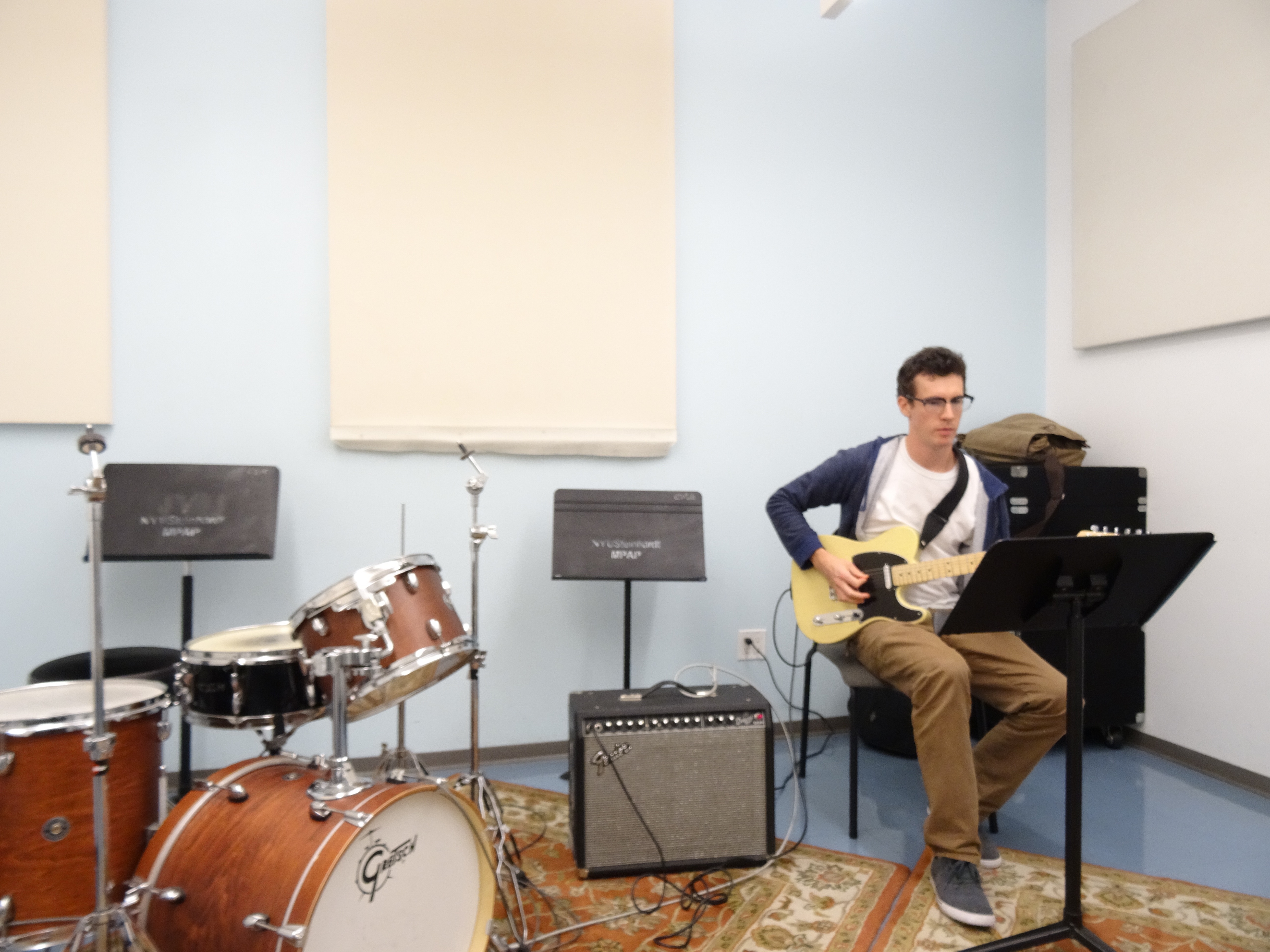
On Friday night, I went with a posse of NYU jazz students to Cornelia Street Cafe to hear the brilliant Brazilian Trio of Chico Pinheiro (guitar), Eduardo Belo (bass), and Ari Hoenig (drums)— for the record Ari is not Brazilian, but he is perhaps the most skilled and tasteful drummer I’ve ever seen live. Back in early August, this trio was actually the very first band I saw perform in New York City. On Friday night, just like the time before, the band played with expert skill, incredible taste, and pure joy. They were a delight to listen to and an example of the height of human musical potential. Chico was especially inspiring to me as he seemed to make every note, whether loud, soft, short, or long, sing with musical purpose.

Yet unlike the first time I saw the group, this time a dark cloud hung over my enjoyment of the show. When I heard them play in August, you could likely find me and many others like me laughing confidently about the immanent election of our nation’s first female president. Life was good, our future was safe, and I could listen to beautiful Brazilian jazz free from worry. And yet here we are now. As we all go about trying to enjoy and prosper in our lives, there’s a giant sack of sub-human filth and his band of morally bankrupt mouth-breathers in the Whitehouse launching daily attacks on the Constitution, scientific knowledge, education, human rights, and basic undeniable facts.

As much as I did enjoy the show, I was distracted by the thought that there are much more pressing issues to address than the temporary entertainment of thirty or so erudite jazz lovers in a small bar. This is not meant to be a criticism of the band at all. Each artist has the right to express themselves however they wish; furthermore this trio undoubtedly brings joy to whomever listens to them. I’m pointing more towards a question for myself: what do I want from music? Since arriving here in August, I’ve been practicing hard to attempt to approach even half of the pure musical skill of someone like Chico Pinheiro. And yet ever since the inauguration of our nation’s first orange president, I’ve been yearning to get in touch with music’s more political face. In that spirit I would now like to share with you nine of the great American protest and political songs of the 20th century and today.

  1. Rebel Girl— Joe Hill 1915

https://www.youtube.com/watch?v=hR7fBCENkN0

There aren’t any recordings of Joe Hill singing his pro-worker songs so we’ll have to rely on this adaptation from Hazel Dickinson. Not to insult your intelligence, but due to the southern twang of this recording, I feel I must clarify that this is certainly not a “rebel girl” in the sense that the confederate flag is called the rebel flag. This rebel girl is someone who is rebelling against the oppressive working conditions in the early 1900s. I’d also just like to say that there is something terribly wrong when America’s president in 2017 has more antiquated views on women and human rights than someone born in 1879.

2. Strange Fruit— Abel Meeropol 1937

https://www.youtube.com/watch?v=h4ZyuULy9zs

This was originally a poem and was first recorded as a song by Billie Holiday in 1939. It’s heartbreaking metaphor linking a tree’s fruit to victims of lynching is perhaps still the most stirring and powerful protest song of American racism.

3. This Land is Your Land— Woody Guthrie 1944

https://www.youtube.com/watch?v=wxiMrvDbq3s

This song has experienced a resurgence lately as numerous artists have played and sung it in protest of Trump’s racist immigration ban. Although the more scathing verses were not originally released, this was a protest song from the beginning.

4. Alice’s Restaurant— Arlo Guthrie 1967

https://www.youtube.com/watch?v=m57gzA2JCcM

Musical resistance ran in the Guthrie family. I’m certain you don’t have time to listen to all 18 minutes of young Arlo’s meandering anti-Vietnam War epic, but you should make time.

5. The Revolution Will Not Be Televised— Gil Scott Heron 1971

https://www.youtube.com/watch?v=qGaoXAwl9kw

No the revolution will not be televised, but it will probably hit Twitter.

6. Hurricane—Bob Dylan 1975

https://www.youtube.com/watch?v=-D7EJS2nnbc

Plenty has been written for good reason about his political songs from the early 1960’s, but this song from his 1975 album desire is my personal favorite Bob Dylan protest song. It chronicles the racism towards and wrongful imprisonment of the boxer Rubin “Hurricane” Carter, and it just sounds really great.

7. Fuck Tha Police— NWA 1988

https://www.youtube.com/watch?v=9jOqOlETcRU

I can’t think of a more direct articulation of the frustration felt by black people after dealing with systemic racism on the part of the police. Unfortunately this song still feels relevant today.

8. Raegan— Killer Mike 2012

Noted Bernie Sanders supporter and rap genius Killer Mike wrote this song eviscerating the policies and legacy of Ronald Raegan. He viciously criticizes the war on drugs, Raeganomics, and Raegan’s foreign policy over an excellent instrumental made by his future Run the Jewels partner El-P.

9. Can’t You Tell— Aimee Mann 2017

This is just one of the many trump protest songs coming out daily. To hear more I’d encourage you to visit 30days30songs.com where the site’s producers have promised to assemble a playlist of 1,000 songs to help us all get through the next four years of “what promises to be a tumultuous and frequently dispiriting and certainly bizarre presidency.” Among new songs from Death Cab for Cutie, The Gorillaz, Mavis Staples/Arcade Fire, CocoRosie, and others, I chose this song from Aimee Mann for it’s emotional depth and because I just love the sound of her voice.

Music is a multiplicity. There is not a single right way to use or experience music. It can provide a sweet escape (hi pop music), mine the depths of harmonic, rhythmic, and melodic possibility (hello jazz), or get you pumped for your intramural basketball game (hey Space Jam soundtrack). It can also give a powerful and infectious voice to the resistance of oppression and injustice. In the dark shadow of the Trump presidency, it is cleansing, empowering, and important to turn on and tune into the righteous voices singing of justice, freedom, and equality for all.

https://www.youtube.com/watch?v=p3L-gL4XmjM

Here at NYU I am exposed daily to some of the most talented and successful musicians in the world. I’ve never been (and likely never will be again) surrounded by such a diverse and eclectic group of true musical masters. By virtue of this, I’m gaining a clearer picture of what it takes to “make it” in the musical world. No, I cannot point to a single factor that will guarantee musical success—  anyone who is in the business of reducing success to a single factor is probably trying to sell you something. There are always many unique elements— talent, discipline, luck, influential friends, facial symmetry, instrument choice, era, location, etc.— that may have lead a musician to his or her brand of success. Yet among the multitude of varying success factors, there is one thing that I think all the musical masters have: Love.

That’s right kids, buckle up, because this blog post might get a little sappy.

This seems obvious, but it is worth stating anyway: you have to love music to be successful at music. True, I can’t think of any musician I know who doesn’t love music, but I can think of a lot of musicians (myself included) who sometimes forget about that love because we are distracted by concerns like making money with music, pleasing an audience, or becoming a better musician. There’s certainly nothing wrong with considering those things, but I think it is important that they not cover up the essential fact that we are doing all of this because we just love music.

This semester I have the incredible honor of taking both an improvisation class and a guitar ensemble with the great John Scofield. By all measures John Scofield is one of the greatest and most important living musicians— he is an incredible guitarist and a prolific artist who has recorded and performed alongside jazz legends such as Chet Baker, Miles Davis, Charles Mingus, Herbie Hancock, Jim Hall, Tony Williams, Joe Henderson, and many more. Here is a man who (rightfully) could carry an air of self-importance— and yet what shone through when I met and interacted with him was just a selfless, joyful, and gracious love for music. After a two hour guitar ensemble in which he patiently played arrangements of his songs (at much slower tempos) with me and four other guitarists, he then treated us all to an impromptu rendition of the beautiful standard Days of Wine and Roses. It is clear that he doesn’t think of himself as “the great John Scofield” the way that we do as fans. Instead, he is the great musician that he is because he maintains a deep love for music that pushes him to keep playing, learning, and listening.

On Wednesday I was treated to another lesson in love by the delightful Mary Scott,  the widow of the English saxophonist and jazz club owner Ronnie Scott. Ronnie Scott’s Jazz Club opened in 1959 and has been the most important jazz venue in London ever since. In 1964 Mary Scott, an avid lover of jazz, ditched her nursing studies and began working at Ronnie’s, thus beginning a long series of interactions with some of the greatest jazz musicians of all time. She spoke to all of the NYU jazz studies grad students about the onstage power and offstage antics of people like Ben Webster, Chet Baker, Stan Getz, Buddy Rich, Wes Montgomery, and countless others. She told us that when Bill Evans played there you could hear a pin drop in the room because everyone in the audience was listening to the beautiful music with rapt attention. She said that Sonny Rollins would always treat the club staff to an after hours solo concert that would sometimes last until the sun came up. All the while that she was telling us these amazing stories, Mary was glowing with sincere love for the music and musicians.

Again, there are countless reasons that Mary Scott and John Scofield have gotten to live the incredible lives that they’ve lived. You cannot discount the luck of simply being at the right place at the right time. Yet John and Mary’s experiences couldn’t have happened to just anyone. A fundamental reason that John Scofield has gotten to perform and record with brilliant musicians and that Mary Scott has gotten to hear them and know them personally, is that each has a deep devoted love for the music.

A lot of things need to go right for you to be success in anything. I can’t tell you what the right conditions are for you to become a famous musician, or a well known author, or a brilliant inventor— I’ll leave it to Malcom Gladwell to tease all of those out. However (no matter how corny it sounds) I do know one thing: you have to have love.

I’m proud to say that I took a trip to Washington DC last weekend to participate in the historically huge Women’s March on Washington. Unfortunately, my whole trip was a near perfect demonstration of Murphy’s law. The most flagrant tragedy of the weekend was obviously that a fleshy orange sack of unchecked ego was sworn in as our nation’s 45th president, yet my personal experience of the weekend also included setback after setback.

My original plan was that I would hitch a ride to Maryland with my friends Jonathan and Tina (who were also going to the march), take the train into DC to stay with another friend Friday night, and then go to the march on Saturday morning. We did depart on Friday afternoon, yet what Google maps claimed would only be a four hour drive ended up taking closer to seven and a half as we travelled among thick unrelenting traffic. Thus, I called my friend in DC and told her that I was going to get in too late and decided to just sleep on the floor of Jon and Tina’s hotel room.

After the long journey Jon and I desperately desired some beer in our bloodstream so we walked to a nearby gas station only to discover that in College Park, Maryland, you cannot buy beer in gas stations. So we then drove down the street to a bar (aptly named “Bar”) and settled in to some stools next to the locals. The first thing that happened was that we witnessed a drunk man in a powder blue sweatpants and hoodie getup being kicked out of the bar for pouring extra booze into his drinks from a flask in his pocket; the second thing that happened was that we were ignored by the bartenders for a solid ten minutes before we got to order our drinks; and the third was that our conversations was hijacked by a man spouting the conspiracy theory that Donald Trump was hypnotizing the populous with those weird hand movements he does.

The next morning, we drove down to the train station, parked a block away in a seemingly pleasant little neighborhood (Jon described it as “where your grandma would live”), and then took our place at the back of what I’m certain I can accurately describe as the longest line in the history of College Park, Maryland. We waited in line for roughly and hour and a half before we finally reached the machines that were dispensing metro cards. Go figure, as soon as I got to it, my machine decided it didn’t want to print metro cards anymore. Thus, I had to merge into another line and wait just a little longer before getting my card.

We finally packed ourselves into a train full of fellow marchers and made the trip into the heart of DC. We didn’t make it in time to hear the many wonderful speakers at the event, but we did get to march, chant, and wear ourselves out for a just and beautiful cause. Around 5pm we boarded another train and began our return journey and we were two stops away from our destination when the train suddenly stopped, broken. Everyone on the train waited helplessly, packed shoulder to shoulder for over an hour before another train came to slowly push us back to the previous stop. We finally boarded another train and made it back to good ole College Park, Maryland around 8pm, still anticipating a long drive back to NYC. We wandered back to the car and discovered that the back right window was smashed. Jonathan’s and my bags, each containing our laptops, were stolen.

Like I say, it was a near perfect display of Murphy’s law. Near perfect, but not perfect, because there was one glaring exception to the rule: The Women’s March was an unequivocal success. In DC and across the nation, people engaged in what was likely the largest demonstration in US history— a demonstration that despite it’s size and fervor incited no violence, and required no arrests. I was in awe of the sight of the seemingly endless sea of people marching past the Capital and the White House and on to the national mall, and invigorated by the energy that ran through the entire crowd. Every fifteen minutes or so I would hear a distant swell of jubilant screams that grew louder and louder until it swept over our portion of the march in a continuous wave. It was incredibly inspiring to come together in solidarity with so many people and affirm our belief in human rights for all people. For this was not so much a march against a truly despicable man, but a march for the rights of the historically disenfranchised. Sure, there were plenty of anti-trump chants (my favorite being “he’s orange, he’s gross, he did not win the popular vote”), yet there were just as many simply affirming basic rights (“My body, my choice! Her body, her choice!”) or basic tenets of American democracy (“Tell me what democracy looks like! This is what democracy looks like!”).

I do hope that we the people never again have such a dark reason to show up by the hundred thousands and affirm our belief in basic human rights, yet it was an incredible moment, a beautiful sight to see, and I felt extremely lucky to be there. The silver lining of electing a grotesque, sexist, xenophobic, neo-fascist, climate-change denying, cartoon super-villain as our president is that a massive number of American citizens now feel inspired to do things like call their senators, protest, and engage in civil-disobedience (parts of democracy that I and many others overlooked during Obama’s presidency). For all of the evil actions that Trump is going to attempt, I hope that there will continue to be equal and opposite reactions from the millions of people in the United States that truly believe that “all [people] are created equal, that they are endowed by their Creator with certain unalienable rights, (and) that among these are Life, Liberty, and the Pursuit of Happiness.”

I spent the majority of my waking hours last weekend either sitting in a car, creeping along in bumper to bumper traffic, standing in a line, or packed shoulder to shoulder with strangers on a train. I also had my favorite bag, some of my clothes, my journal, a book, and my laptop stolen. And yet if I were given the chance to do it all again, I absolutely would. All of that was a small price to pay to witness and take part in the beautiful, historic, and life-affirming moment that was the Women’s March on Washington. Let us all continue to fight the good fight.

After a month long hiatus, I’m back to blogging. In the past, after having taken a long break from blog writing, I’ve always come back to it with some grand declaration and a clear goal to enact (e.g. I’ll blog everyday, release a song every week, etc…), and I am tempted to do this yet again. We are after all still within the window of opportunity for me to tell you all about my multiple new year’s resolutions! I’ve asked around, and it seems like most of my friends are not as enthusiastic about the idea of new year’s resolutions as I am. Personally, I love to make resolutions. It feels great to set big goals, and dream of what my life will look like when I’m living as my peak self.

I’m also certain I could squeeze out a whole blog post simply by talking about the what, why and how of my new year’s resolutions. I’d feel great about myself and all my ambitious plans, and yet you the reader might actually feel a little bit worse. The best case scenario is that you’d get bored and just stop reading. The worst case is that you would think “Wow, Lucas sure is going to do some awfully cool stuff this year! What am I going to do? Not much. I suck. I hate myself. You know what, I hate Lucas too.” Look, I don’t want you to hate yourself, and I especially don’t want you to hate me, so instead of talking about all of my goals and (hypothetical) future achievements, I’m going to try the opposite approach and talk about some of my past shortcomings. Because a little dose of schadenfreude does a body good— it’s my New Year’s gift to you! You’re welcome.

For as long as I can remember, I’ve carried two (mostly subconscious) desires that have motivated much of my behavior: the desire to be liked, and the desire to be the best. In many ways, these desires have served me well in my life. I think I’ve generally behaved in a well-mannered, somewhat delightful way, and a lot of people have liked me because of this (or in the least, they’ve not disliked me). Additionally, I’ve put a lot of effort into being really good at things like music, sports, and school, and as a result I’ve been a relatively high achiever in these fields. And yet, for the past decade or so, as I’ve sought to create, sustain, and grow a vibrant musical life, I’ve discovered that these motivating desires have provided more hindrance than help.

Consider this: one of the best ways (if not the very best way) to improve at playing music, is to play with musicians who are better than you. Here at NYU, and in New York City as a whole, I am surrounded by musicians who are more experienced than me. I have ample opportunity to play with them in both impromptu and organized jam sessions all over town. And yet last semester, I consistently avoided these opportunities, because I have this desire to be one of the best in whatever realm I enter and it feels very uncomfortable for me to be one of the very worst. But if I really am serious about improving as a musician, I’ll quit ego-tripping right now and start getting comfortable with playing with people who are far better than me.

Ultimately I also wish to compose my own music and release it in to the world, and it would be a dream come true if I could earn a living by writing original music. Although it is a relatively rare livelihood, I don’t even think it is all that far-fetched. I know that I can write music that sounds pretty good, and I see numerous outlets for original music: movies, TV shows, video games, advertisements, live performances, or sold directly to an audience (who knows, maybe even old-school aristocratic patronage will come back into fashion). Yet success in any of these realms requires at least one common thread: the willingness to put my music out into the world. Sure, I’ve done this on a small scale— I’ve written some original songs, made some home recordings, and put them up on sound cloud. That counts right? No, not really. The stakes are too low. I’ll never truly know if people like it or dislike it, and that is the hurdle that I am hesitant to jump over. For I have this crippling desire to be well-liked and approved of, and I am afraid that if I put my music out into the world and really try to sell it, people just won’t like it. Yet the fact is, no matter what, some people will not like my music. It’s impossible to write universally loved music— go ahead and try; you’ll end up writing elevator music. If I really am serious about making music my livelihood, I’ll accept that many people are not going to like my music, and just put it out into the world anyway.

Yes, I’m a scared little piglet everybody— I’m afraid of not being the best and I’m afraid of not being liked. Yet I have some virtues as well. In the least, I have an awareness of my fears, and the gall to confess them to you all. I’ve shared these shortcomings with you because I want to move beyond them. As Louis Brandeis said—guys, wait, listen, I’m not going to act like I knew who Louis Brandeis was before I wrote this, I was just vaguely aware of this quote and so I looked up who said it. Anyway, as Louis Brandeis said, “publicity is justly commended as a remedy for social and industrial diseases. Sunlight is said to be the best of disinfectants.” Well, this blog is my publicity, and you readers are the sunlight, here to help me clean up my act. Thanks for reading.


dennis-rodman-dive

So a couple of months ago I was waiting on the C train listening to an old man play what sounded to me like Bach on his electric piano. Despite his lowly stage and modest pay, he was playing beautifully and so I looked around to see if any of the other awaiting subway riders were noticing his performance. To my delight I looked up and saw one young woman listening with rapt attention. After dropping a couple of dollars in his keyboard case, I boarded the train and ended up standing right next to that woman. So I did what few New Yorkers ever do, and I struck up a conversation with a stranger on the train. I asked her if she was a musician, and she said no but that music was a big part of her life and that she was actually involved in film (acting, writing, directing, producing, etc…). We chatted about a short film she was producing and eventually I told her that if she ever needed anyone to score her films, that she should call me. I gave her my card, bid her adieu, and got off at my stop, satisfied with the exchange, but not exactly expecting anything to come from it.

Well, I must have made a good impression (either that or she couldn’t resist the low, low price I promised her), because a few weeks later, she called me about scoring the short film that she was producing. Sidenote: kids, it turns out you should definitely talk to strangers, because they’ll end up hiring you to score their films. So for her privacy and my own entertainment I’m going use a completely made up name and call this producer Lilliandra (I estimate there’s an 85 percent chance Lilliandra is going to read this blog, so I hope you enjoy your made up name, Lilliandra). Lilliandra was working alongside the writer/director/star of the film— let’s call her Nira— to put the finishing touches on the work. The film is a comedy with a surprising dramatic turn set at a low-key house party in Greenpoint, Brooklyn. Both Nira and Lilliandra admitted that there are some editing issues, and some suspect acting on the part of one of Nira’s costars, yet overall I found the film charming, funny, and heartfelt, and Nira shines as a magnetic personality onscreen (off-screen as well in fact). I was happy to be a part of the project, and after some direction from Nira and Lilliandra, I began writing and recording the music for the film. After a week of hard work I had something I was excited to show them, so we set up a meeting at Nira’s Greenpoint apartment.

Yet after showing them my work, I could already see the unfortunate truth on their faces: the music was not right. In a nutshell, the music stepped on the humorous parts and over-dramatized the dramatic parts. Despite the fact that Nira and Lilliandra let me know this very delicately, I’m ashamed to admit that internally I felt very defensive. I thought “didn’t they know how much work I had done… and this music is really good…and I’m giving them a low, low price so they should be happy with what I gave them… etc.” Yet all of this was simply the ego-trip of a rookie film composer faced for the first time with some real life critique of his work. If I am going to continue in this business (which I certainly hope to), I need to grow thicker skin and be perpetually open to direction, critique, and even outright rejection. Lilliandra and Nira were right after all— I had stepped on the jokes, and over-dramatized the drama.

Ultimately, however, I was guilty of something more egregious than simply writing bad music. I had essentially used this film as a forum to show off my abilities as a composer, rather than simply trying to help tell the story. The music was in fact “good” in the sense that it was well crafted and sounded nice, but it was the wrong music for this film. Nira and Lilliandra were going for something more nuanced than what I had presented. My music was outshining the film at the expense of the story.

Likely most of us at one point or other have been guilty of bolstering ourselves at the expense of the larger community or project that we are a part of. In the least we’ve all seen it in the losing basketball team with a selfish “all-star” taking all the shots (I’m looking at you 2015 Kobe Bryant), or the band with lazy songwriting that simply serves as a forum for the lead guitarist to shred painfully long solos (I’m looking at you jam-band scene). Yet the best and longest lasting actors, musicians, athletes or workers in any field are not those who do everything to make themselves look better, but those who realize that they are a part of a bigger picture and simply play their part very well (I’m looking at and applauding you Dustin Hoffman, Dennis Rodman, Steven Drozd, and everyone of their ilk).

Last night I met again with Lilliandra and Nira. I had made many adjustments according to the direction they gave me, and as a result the film’s story and personality was much more clear than it had been in the previous incarnation. We had a pleasant and productive session of simply fine-tuning the musical elements, rather than having to completely re-work them. The night was fun and fruitful because we were all on the same page, telling the same story, and each playing our part.

 Ashtray from Alan Cristea Gallery Twentieth Anniversary Portfolio 2015
Ashtray from Alan Cristea Gallery Twentieth Anniversary Portfolio
2015

Yesterday I went on a Tinder date to the Museum of Modern Art. There’s no real reason for me to tell you that I was on a Tinder date except for the fact that I probably just won a few more readers who are titillated by the phrase “Tinder date.” And now, despite the fact that I keep repeating the phrase Tinder date, I’d like to direct your attention more towards my experience of the MoMA and less on the Tinder date. I confess that at the MoMA I felt a lot like how my German friend Dierk feels feels when he watches a Richard Pryor standup comedy special: “I don’t get it!” (please imagine a deep-voiced German man saying that). I could chalk this up to the fact that I am not well-educated and up to date on the trends of modern visual art, but I actually experience this same feeling when listening to some modern musical art (a field in which I’m at least relatively well educated and up to date). The truth is that some art and music is simply more intelligible than other art and music.

For instance, I had a wonderful experience of perfectly intelligible music last Saturday at the legendary Blue Note jazz club. At the classic venue, looked after by a suspender-clad waitstaff, I saw the one and only Bill Frisell play alongside Petra Haden (vocals), Thomas Morgan (bass), and Rudy Royston (drums). With his trademark reverb-laden telecaster tone, Bill and company played arrangements of classic film and television music from their album When You Wish Upon A Star. They put a haunting and spacious twist on classic movie songs like You Only Live Twice, The Windmills of Your Mind, and the theme from Psycho. Yet for all of the unique character that they infused in each song, they never sacrificed clarity for the sake of novelty. I walked back to the subway feeling uplifted, whistling the tunes that I had just heard.

Conversely, on Tuesday night I took a stroll to a new venue called Nublu— this is likely a stretch but I wonder if the phonetic pronunciation of the club (“new blue”) is an intentional nod (or perhaps even a jab) towards the long-standing Blue Note. Nublu, with it’s darkly lit industrial aesthetic, glowing bar, and psychedelic tapestry of light projected onto a large wall, was clearly much more modern than the Blue Note. As I watched the band tune up and prepare to play, I realized that this was one of the most talented collections of musicians I would ever see perform together (Dave Binney-sax, Chris Potter- sax, Adam Rogers- guitar, Matt Brewer- bass, Craig Taborn- keys, and Justin Brown- drums). Between the sleek setting and incredible musicians, I had a giddy sense that this was one of these “only in New York City” kind of moments. And yet after thirty minutes of hearing them play relentless, high energy, complex, and sometimes atonal music, I was ready to leave. There was no doubt of the skill onstage with each performer playing blistering solos— there was simply little for me to latch on to and enjoy. I left with nothing in my head that I wanted to whistle.

“What ever happened to melody!?” This was a question my film scoring instructor Chris Hajian asked me this week in our lesson, and a question I was asking myself after the show at Nublu. For the past couple of decades or so (and probably much longer), whether in jazz, or film scores, or pop music, the importance of melody has undoubtedly waned. For example, what’s the billboard number one song right now? Don’t worry I’ll look it up— ok it’s a song called Closer by the Chainsmokers. Now I just really hate this song already, and I’ve only heard it once, but let’s identify what is important and prominent about this song: the beat, the timbre change from the male vocals to the female vocals, the distinct intentionally lo-fi sound of the synth, and of course the corny, cliché, stupid ass lyrics. It is certainly not the melody that is important. The melodic moments are short, simple, and repetitive— this is certainly not a hit song because of the melody alone. Ok now then what was the number one hit on this day in 1996? Oh no, it was the Macerena! I was hoping to prove that 1996 was more melodic than 2016, but that is not a great example now is it? Ok we better go even further back in time… on this day in 1976 the number one song was Chicago’s If You Leave Me Now. Whether you like this song or not, you’ll have to admit that the melody plays a much more prominent role in it than in most of the hit songs of today. There’s strong contour, momentum, and variation in this melody. Indeed, unlike the song Closer, the main reason that If You Leave Me Now was a hit is because of it’s melody.

And now, straight out of the blue, it’s time for me to stop being pretentious and start getting real. I’m abruptly signing off of this blog post, because I have a laundry list of other things to do including film clips to score, guitar solos to transcribe, and Westworld to watch. But are you still wondering why melody has diminished over time? And do want to know how my Tinder date went? And is this a complete cop out ending the blog post like this? Stay tuned for the thrilling conclusion next week as these and many other questions are finally answered!!


img_1132

Last week I was in a coffee shop struggling to write a blog post about booty, when I started eavesdropping on an amusing conversation. I listened as the shop’s two hipster employees spun a random web of banter (from farmer’s markets to penne pizza to Keurig coffee to that business card scene in American Psycho) and suddenly I had a sad realization: eavesdropping on this conversation was the most interesting thing I’d done all week. I was struggling to write the blog post because I didn’t do anything worth writing about that week— I just went to school, practiced, did my homework, ate food, watched game of thrones, read Harry Potter, and slept. It was a good week— but a boring week to read about, so I was stuck mining my mind for some interesting concepts. But concepts are not interesting— they’re just dead ideas unless you do something with them. So I vowed then and there that the next week I would go out and really do something, because (dammit) I live in the most vibrant city in the world, and (dammit) I need these blog posts to be easier to write. Thus, I’d like to throw out the tired old concepts this week, and just give you a recap of some of the more interesting things I did.

I began my adventures last Friday night by taking a stroll down to Union Square (well known hangout for eccentric characters). I was just eating an apple doing some people watching when I saw a large mass of people circle up and heard someone from the inside suddenly shout “If you’re loving the Cyphers put your fist up, and say hell yeah!” (and naturally all the spectators put their fists up and shouted back “hell yeah!”). I approached the crowd and soon realized that there was a hip-hop beat playing and many people trading freestyle verses over it. Apparently I had walked into a meeting of the Legendary Cyphers, a renowned freestyle session that happens every Friday night in Union Square (read about it here please). Many of the MC’s were wearing Legendary Cyphers shirts, most were just in plain-clothes, and one guy was inexplicably wearing a full Aquaman costume. I learned from their verses that they were honoring an MC called Majesty, one of the founding members of the Legendary Cyphers who had recently passed away. I was captivated by the scene— some of the MC’s were incredibly talented and effortlessly picked up where the previous rapper had left off, then spitting a clever collection of puns, metaphors, and cultural references. Some of the MC’s were clearly amateurs, yet this was obviously a safe, supportive space with the beginners being lifted up by the heavy weight MC’s rather than put down by them. If one rapper began to flounder, there was no dissing or booing—another MC would simply pick up where he or she left off and the cypher would continue. For the roughly hour-long duration that I watched, the rapping never stopped. The beats would change every five minutes or so, yet the MC’s never stopped flowing. As I watched I was constantly aware of the many similarities between this and a jazz jam session, but that is the topic for a future blog post…

The next day I decided to do something I have not done in years: watch an Arkansas Razorback football game. There’s a bar in Times Square called Hurley’s Saloon that hosts watch parties for Razorback sporting events (don’t ask me why). I wanted to go hear some Arkansan accents so I threw on a red shirt and brought my buddy Jonathan along to watch Arkansas get royally stomped by Alabama (coincidentally, Jonathan went to the University of Louisville who is currently having success under the memorably-fired former Razorback coach Bobby Petrino). We sat and drank some beers and I told Jonathan that I wanted to go talk to the people at the table nearby. He seemed doubtful that I would actually cold approach a table full of strangers and introduce myself, but he’s never been to Arkansas and doesn’t understand how small of a world it is there. So I got up and introduced myself to a table of five women (oh maybe it was the “five women” part that made him doubtful), and after some brief small talk I discovered that two of them were indeed in Bible study with my aunt Martha Jane at First Methodist church in Hot Springs, and one of them was an assistant principal at Pine Bluff High School when my friend Epiphany Morrow was a student there. To borrow a term from Malcolm Gladwell, Epiphany and Martha Jane are “connectors.” They both know a lot of people and a lot of different types of people. I’ve been very lucky to have been propped up and helped along my life’s path by a number of friends and family members who are connectors. Because of this, I too aspire to one day be a helpful connector to many people in my life, but that is the topic for a future blog post…

My week at school passed by with plenty of practice and classwork, and by the time Thursday rolled around I was ready for another outing. A fellow guitar student at NYU named Ben recommended I go see the excellent guitarist (and NYU professor) Adam Rogers perform at 55 Bar with his power-trio Dice. Rogers is mostly known as an accomplished jazz guitarist, but in this band he breaks out a Fender Stratocaster and fully flexes his rock muscle. He still played with his trademark technical skill and advanced harmonic and rhythmic ideas, yet he did so in the context of arrangements of songs by Sam Cooke, Bobby Womack, and Jimi Hendrix, as well as some heavy-hitting originals tunes. It was fun and invigorating to see such a great performance, yet watching Rogers play this style of music was inspiring on another level as well. For I imagine that the current generation of jazz guitarists did not first pick up a guitar because they heard a Kenny Burrell or Wes Montgomery album. They were probably first inspired by rock gods like Jimi Hendrix or Jimmy Page and only later seduced by the deep well of musical ideas that the jazz cats provided. Thus, it was great to see present-day Adam Rogers playing something that I imagine a 13 year old Adam Rogers would have enjoyed— certainly my 13 year old self would have enjoyed it, but that is the topic for a future blog post…

I keep harping on this phrase “the topic of a future blog post” to show that simply by going out into the world and doing something (anything really), I have gained, if I want to use them, ideas for at least three new blog-posts as well as concrete experiences to support them. Whereas last week I spent hours upon hours struggling to write a purely conceptual post, this week’s post flowed easily from the pen to the page (and then from the fingers to the screen as I typed it up). Yet because I’m a conceptual kind of guy and I can’t stay away from abstract ideas for too long, I’d like to leave you with what I think is the underlying lesson of this week’s post: The more that you do, the more you that you can do. The more you practice your craft, the more gigs you’ll be able to handle; the more people you go out and meet and invest yourself in, the more people you’ll have to help you in your personal and professional life; and the more you just get out of the house, the more you’ll have to talk about in your music blog. See you next week!


dsc00490

Watching the presidential debate last Monday was similar to what it would be like to watch the mighty German national soccer team play a match against the tiny nation of Belize* if all the Belizean players were drunk and high on cocaine. Imagine: Germany is far and away the better team, relentlessly and smugly scoring goal after goal after goal on Belize, yet the intoxicated Belizean players refuse to recognize any of the goals scored on them. Belize stubbornly pretends they’re tied and that its an even match. They celebrate furiously every-time they administer a violent slide tackle or use their hands and try to throw the ball in the goal. Also the referee is Lester Holt, and he obviously has no control over this shit-show of a match.

Now I’m not suggesting that Hillary is as precision perfect at debating as Germany is at soccer, nor am I suggesting that Donald Trump debates like he’s drunk and high (although he was sniffling a lot, rambling on and on, yelling… you know what, maybe I am suggesting that). I’m pointing out the vast difference between Hillary and Trump that was exposed by putting the two candidates on stage with each other. One came across as being competent and substantial, and the other came across as being as competent and substantial (and aesthetically pleasing) as a chicken McNugget.

And yet, Trump still has his supporters. No matter what ridiculous, inaccurate, or offensive thing he says, a lot of people are still going to vote for him. The logistical and ethical holes in his policy plans do not deter Trump supporters. They just like the way he talks: simple superlative adjectives delivered in a coarse, firm tone and a healthy dose of xenophobia. That or they just hate Hillary— probably continuing in the ages old trend of hating or distrusting women, what with their vaginas and everything. Hillary can present all of the well-researched, plausible policy plans in the world, she can continue to not say racist or offensive things in public, and she can tout all of her experience in both the white house and senate, but she will not sway some people.

I’m not going out on a limb by saying that Hillary is objectively more qualified to be president than Trump— yet that’s not what matters to people. Do you like Hillary? Or do you like Trump? That’s the question. To use a musical example (this is a music blog after all), let’s address an old question: Beatles or Rolling Stones? Sure you can like both (I do), but everyone likes one a little more than the other. Some people are going to fight me on this, but I’m also not going out on a limb by saying that The Beatles were the more musically advanced group. The Rolling Stones never wrote music in odd time signatures, they never utilized a Bach-influenced piano solo, or borrowed from Indian Classical music— The Beatles did (Here Comes the Sun, In My Life, and Within you, Without You, respectively). Yet I am not going to try to convince you that you should like the Beatles more than the Rolling Stones just because they are more musically intricate. If you like the Rolling Stones more than the Beatles (or vice versa), you do so because you just like the way they sound, and that’s fine. Unfortunately political decisions are a lot like this as well— I contest that they aren’t always (or even often) informed intellectual decisions about who would make the best political leader. Most likely, if you support Trump, you just like his Trumpiness, and if you support Hillary, you just like her Clintinivity (and the truly inspiring fact that she could be the first woman president).

I suppose I was comparing Donald Trump to the Rolling Stones in that last paragraph, and for that reason I would like to sincerely apologize to the Rolling Stones. I also don’t want Hillary to start thinking she’s the Beatles of politics (whenever she reads this blog post). These two candidates are not the Beatles and Stones— we’re dealing with two of the most hated candidates of all time. If I’m searching for comparable musical acts, I’d say this election is closer to The Backstreet Boys (Hillary) vs. Milli Vanilli (Donald Trump). If you don’t remember Milli Vanilli, they were the German R&B duo popular in the late 80’s who were eventually outed for not actually having sung any of the vocals on their album and for lip-syncing at all their concerts. They were just models posing as singers (perhaps not unlike many singers today). Similarly, Donald Trump is just a super rich guy posing as a politician (perhaps not unlike many politicians today). The longer he sticks around, the more likely it is that he will be exposed as the phony that he is— I only hope we don’t have to elect him president for him to be fully exposed.

For as much as I clearly detest the man, I also feel sorry for him. It must be hard to so often stand up in front of people and not know what the hell you’re talking about— Lester Holt’s asking you questions about creating jobs, and you just want to go watch the Bachelor. I admit that I sometimes feel a little bit Trumpy in my NYU jazz studies master’s program. Compared to some of my other classmates, I don’t sight read very well, I don’t know as many tunes, and I’m not as familiar with the Jazz language, and yet when it is my time to take a solo, I have to come up with something to say just like the rest of them. Between trying to simultaneously navigate the song form, the guitar fretboard, and the sound of the band at large, I sometimes get lost and basically don’t know what the hell I’m playing or what I should be playing. I end up just rambling on incoherently.

The difference between me and Trump (well, hopefully not the only difference) is that I am not trying to pull the wool over anyone’s eyes. When I suck (and I suck often), I want to do it freely and openly in front of my teachers and classmates, beckoning them to help me. The repeated embarrassment of this experience will motivate me to practice my craft and elevate my level, and (if nothing else) the fact that I’m paying many thousands of dollars for this education will hopefully motivate my teachers to show me the way forward.

Playing jazz, running for president, and challenging Germany in soccer are all enormously difficult tasks. No one is born ready for these endeavors. Sure, you can pretend you are— you can also pretend your sloppy spray-tan looks really cool. The better idea would be to resign yourself to the difficulty of your goal (whatever it may be), embrace a life-time of honest learning, and walk the long path from mediocrity to competency and ultimately to mastery. That’s my plan at least.

*I want to say that I meant no disrespect to the nation of Belize in this blog. Belizeans don’t get drunk or high more than any other nation (although the white tourists who travel to Belize probably do). Just to clarify I picked Belize because they have a pretty bad soccer team and I traveled there once.


dsc00484

Last Saturday I was sitting at a 2nd avenue bar called the Thirsty Scholar with my friend Jonathan. We were talking about Ashtanga Yoga, jazz jam etiquette, and his time in Brazil when we heard about the bombing in Chelsea. Despite the scare, we let the night steer us to Union square where we watched some chess matches and met a man named William Lombardy, better known as Bobby Fischer’s chess coach. Lombardy made pleasant general small talk with us for about two minutes before he embarked on a free flowing rant which included a denouncement of the NYC judicial system, a discussion of his eviction battle with his landlord, and a scathing criticism of America at large.

And these are the rich ups and downs of New York City. One minute you’re having a delightful conversation with a new friend, the next you hear of a terrorist attack, the next you meet an iconic chess master, and the next he’s telling you how terrible the world is. I’ve only been here for a few weeks (so check back with me in a few years), but my feeling is that this city is neither good nor bad— it’s just superlative. Due to the incredible density and volume of people from all backgrounds and walks of life, NYC offers you both the best and worst of the human experience, sometimes in rapid succession.

Musically (this is a music blog after all), I’m also offered a daily course of both the best and the worst. I got to school and am literally face to face with some of the best musicians in the world (e.g. improvisation class with Billy Drewes, guitar lesson with Peter Bernstein, master class with Ari Hoenig etc…), I then go to the practice room and am faced with my own mediocrity as I struggle to learn Anthropology, and finally as I’m waiting on the subway home, I’m treated to a sloppy rendition of “Hey Joe” by a drunk busker with an abrasive guitar tone (I call it a “sloppy joe”).

As I encounter such a spectrum of musical quality, it’s difficult to not get caught up in the game of comparing myself to other musicians— variably I’ll think “oh man, I’ll never be able to do that” or “he’s 7 years younger than me, how is he so good?” or “pssshhh, I’m better than that guy.” Yet these are not productive thoughts. Even though I am in school and obviously trying to use this time to improve, comparing myself to teachers, or classmates, or subway singers is not a good way to achieve that goal. For ultimately I’m not studying music because I want to be better than anyone else— I’m studying music because I love it and I want to be better capable of expressing it. If I use the desire to be as good or better than others as my motivation, practices and performances become either a chore or a competition (neither all that enjoyable). Yet if I use my love of music as my motivation, practices and performances become a joyful privilege.

Yet this motivation was reduced to an even simpler level in a masterclass with the great Peter Bernstein (no relation to Leonard). One of my classmates asked him the question “what inspires you to play?” He replied “I just try to get down to the basic fact that I like holding the thing, and I like hitting a note and feeling it vibrate. Sometimes I run into trouble if I get more complicated than that.” He explained that he doesn’t really even hope to sound good, because “well, what if I don’t sound good?” This was a revelation for me. Here was one of the most tasteful and talented guitarists in the world (a man who has performed with artists such as Sonny Rollins, Dr. Lonnie Smith, Diana Krall, and countless others) saying explaining that the only thing that he tries to let motivate him is the fact that he likes to feel a note vibrate against his chest.

Pete doesn’t play because he is trying to be great, or because he is trying to be better than anyone else— he plays because he just loves to hear and feel the notes. Musician or not, there’s a lesson here for everyone. Throughout the inevitable ups and downs of life, it is wonderful to always have an activity that you know you love to do. Whether it is music, basketball, painting, or anything else, the surest way to keep doing your favorite activity is to fall in love with the most basic elements. If you can learn to simply enjoy the sound of a note, or the feel of the ball in your hands, or the sight of a brush stroke on the canvas, or even the mere act of breathing, you’ll have learned something really important about living.


img_0967—Sunset at Coney Island, not related at all to this post, but this was my view on Sunday evening—

Billy Drewes can levitate. The jovial saxophonist/composer who has collaborated with Woody Herman, Lionel Hampton, Tony Bennett, Herbie Hancock, John Scofield and countless others, incredibly is teaching my improvisation class at NYU. He used the first day of class to get to know us, the ten bright eyed graduate students in his class, and tell about his background. He included in his rich backstory the fact that on at least three occasions he thought he was levitating: once after being administered a generous dose of codeine at a hospital, once after being put in a euphoric state via acupuncture, and once during a powerful improvisation at a concert with Eddie Palmieri. Each time he had to physically check to see that he was still on the ground, and each time that act of checking broke the spell. After spending a couple hours with him, it’s no surprise to me that he’s accidentally dabbled in levitation. Despite his undeniable status as a heavy-hitter in the music world, Drewes is incredibly light-hearted and easily swept up in his surrounding experience.

Yet it takes much more than happy thoughts to get off the ground in music. After a week of being surrounded by incredibly talented and accomplished students and teachers, it is clear to me that I’m just beginning to crawl. Frankly I’m not used to feeling so far behind my musical peers. In Little Rock I was sometimes told that I was the “best guitarist in town”— that was certainly a gross overstatement yet I enjoyed the ego boost of feeling like I was among the cream of the crop. Here no one is going to accuse me of being the best, nor of being particularly creamy at all. Yet I didn’t come here to prove myself as “the best” (a generally bogus pursuit if you ask me), I came here to learn. And in a mere hour and forty minute class with Billy Drewes I learned several musical tricks of the trade.

“I’d get the most done when I didn’t have my instrument… just singing,” he said, talking about how he would practice. In other words, any instrument has its physical strengths and weaknesses. You’ll be compelled to play or not play certain things depending on which instrument you play. Yet if you are singing or even just thinking music, you have no limitations other than your musical imagination. It doesn’t matter if (like me) you are not the most talented or natural singer— if you start with your mind and voice and then transfer those ideas to your instrument, you’ll often come up with new and more natural ideas, ideas that truly come from inside of you rather than merely existing on the surface of your instrument.

Later in class he asked us “does everybody read pretty well?” and the room fell silent. If its not obvious, he was talking about reading music (let’s safely assume everyone in my graduate program knows how to read words). “That’s an important thing,” he went on “if you don’t have that, you kinda cut yourself off from things.” Drewes was a strong reader when he was at Berklee College of Music in the 1970s, and as a result he was able to get plenty of gigs. He explained why: “It’s a time thing. It makes rehearsals go faster.” If you can read, you can work all the time.

A large part of our class was also devoted to talking about composition. He was curious if any of us composed music, and everyone did except for one. Drewes himself recently embarked on a composition project called “first ideas” in which he wrote 24 pieces of various lengths, styles and textures which were all simply his fist ideas, with no editing or rewriting. He told us when composing to “keep every idea,” a suggestion that was repeated to me later in the week by my Film Scoring instructor Irwin Fisch. For musical content that does not quite fit in with a current piece often proves perfect for a different piece days, months, or even years down the road.

The ideas above seem obvious to me now—perhaps I should have come up with them on my own. Yet ideas like these are easier to trust when they’re coming straight from the horse’s mouth (especially a horse who has made a living since the 1970s performing and composing music, who has collaborated with a laundry list of jazz masters, and who currently plays saxophone, clarinet, and flute for the Village Vanguard Orchestra). Every day at NYU, I’m being inundated with great ideas. Earlier I described this as “learning the tricks of the trade,” but the truth is, I haven’t really learned anything yet. Musical knowledge is not transferred verbally. The only way I can learn these lessons is to sit down and apply them. I confess I am not the best reader, I rarely practice without having my instrument in my hand, and I don’t keep every musical moment that I compose. I’m still crawling. Yet I firmly believe that if I work hard to incorporate the musical wisdom provided by my brilliant instructors here, I too will be able to levitate someday.

By the way, here’s what I’ve been listening to this week: