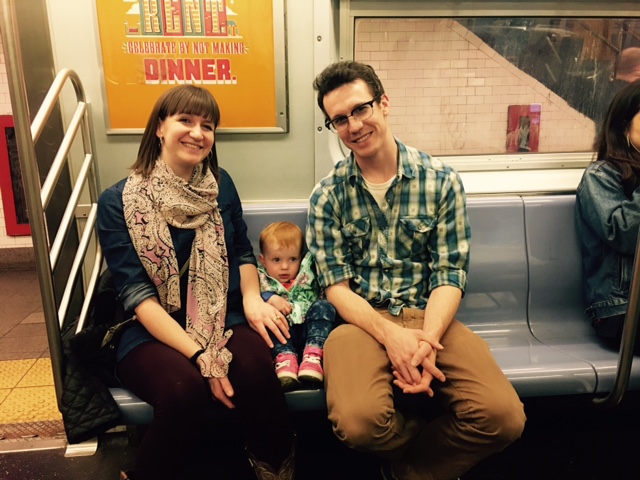
Happy new moon eve everybody! I’m writing this post from Mulholland’s bar in Williamsburg with a Brooklyn Lager in my hand, NCAA tournament basketball on the TV (currently S. Carolina 55—Florida 57), and some very special company by my side. My sister Liza, brother-in-law Joe, baby niece Bridget, and our friend Gaines came to visit NYC this weekend so we’ve had a whirlwind weekend of hardcore hanging out. I know you’re all waiting with bated breath for the four songs I’ve written this moon cycle. You faithful readers of course know that my goal for this moon cycle was to write, arrange, and record four songs. You know that right? Right?
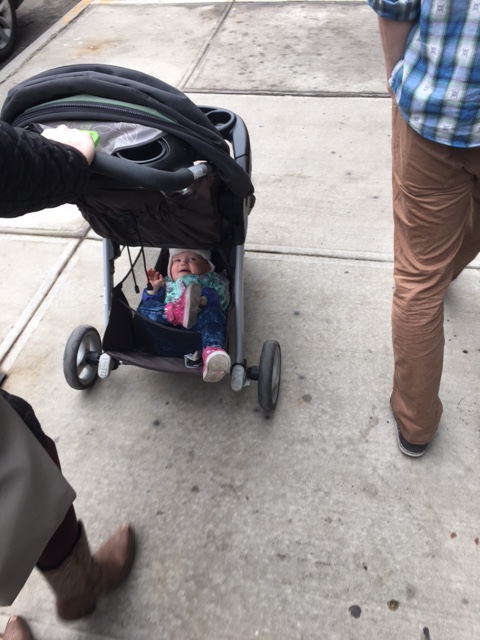
Yeah, you know that. I want to tell you a little more about those songs, but first, look at how cute my niece is.
What were we talking about? Oh yeah, those songs I’ve written— I wrote four songs these past four weeks, and my goal was to share them with you all tomorrow. Yes, my goal was to share them with you tomorrow, but my new goal is to share them with you in a week. Is this a cop out? Yeah, a little bit. But I’m a grown ass man, and can cop out of my goals if I want to. Plus, I have a really good excuse. I could have recorded these songs in time for my Monday deadline if I had spent all weekend recording these songs. Instead I’m hanging out with this goofball!
So anyway, you’ll just have to keep that breath bated while I go enjoy myself. See you next week!
This week, because I enjoy being both efficient and lazy, a large portion of this blog post is going to be the abstract to my master’s thesis. My thesis is due next fall so the final abstract will surely look a bit different than what you are about to see here. This is simply a preliminary abstract that I have to submit tomorrow to the honorable Dr. Dave Schroeder (director of jazz studies at NYU) so he can make sure that i’m not going to do anything terribly misguided or unrelated to jazz in my research. Unfortunately I fear I may be doing something terribly misguided and unrelated to jazz. You be the judge…
“Back in the days when i was a teenager,
before i had status and before i had a pager,
you could find the Abstract listening to hip hop.
My pops used to say, it reminded him of bebop”
-Q-Tip (Excursions)
The purpose of this research is to examine the connection between hip hop and jazz. Certainly there have been a number of jazz artists to utilize hip hop beats in their songs (notably Herbie Hancock, Miles Davis, and Branford Marsalis), as well as a number of hip-hop artists to utilize jazz samples in their songs (notably A Tribe Called Quest, Digable Planets, and De La Soul). Yet the connection between jazz and hip hop is deeper than mere examples of cross-pollination. Herbie Hancock himself has acknowledged the relationship between beboppers composing new melodies over Tin Pan Alley chord changes and hip hop MCs composing new lyrics over funk grooves from the ‘60s and ‘70s, while the journalist Harry Allen proclaimed outright that “hip hop is the new jazz” (Tate, 388).
There are many similarities between jazz and hip hop. Both hip hop and jazz were created and developed by working class African Americans. Each genre served, and often still serves, as dance music (although jazz has in many cases evolved beyond a danceable rhythm, it is interesting to note that Dizzy Gillespie said in his autobiography: “Jazz was invented for people to dance. So when you play jazz and don’t feel like dancing or moving your feet, you’re getting away from the idea of the music”). Jazz and hip hop also share musical priorities such as an “obsession with syncopation and timbral exaggeration” (Tate, 388).
The above are just a few general connections between hip hop and jazz. Yet during the course of this research, I will attempt to discern the exact degree to which hip hop is jazz. I will do this by comparing and contrasting each genre’s creation, and social function, and aesthetic trends. Finally, I will do rhythmic transcriptions and formal musical analysis of verses by notable rap artists in an attempt to discover the musical similarities between dexterous rappers and jazz virtuosos.
What’s up nerds! It’s me Lucas, back from formal research writing land and back in the cozy casual world of blog writing. Seriously, anything goes here! Watch.
See!
Ok, anyway let me soften the blow of my previous accusation. I don’t think that my research will be misguided or unrelated to jazz. I see clear social and aesthetic connections between jazz and hip hop. Yet I do realize that there is potentially a big problem with me exploring this topic: I’m white. Yes, I’m white. I don’t know if you all realized this from the fact that I look, sound, and act really white, but it’s true, I am white. And yet a foundation of this research is the fact that both hip hop and jazz were created by poor and working class African-Americans. I obviously have no idea what it is like to be black or tan. I’ve never known anything other than easy living on Caucasian lane.
If I were to at all try to explain the subjective experience of the creators of jazz and hip hop, I would be speaking about something I know nothing about. Sure, I have black friends, yes I play jazz and hip hop— this gives me the authority to talk about the African American experience right? Nope. Not even a little bit. White musicologists have a rich history of overstepping the domain of their knowledge and experience when analyzing African American music. Early 20th century accounts of blues, jazz, and African American folk songs are full of simplistic and racist portrayals of black people. I hope to avoid this trend at all costs.
Luckily, my research is redeemed by the fact that this is formal academic writing (i.e. the most boring, soulless, lame-ass writing in all the land). In this paper, there will be no room for subjective commentary, simply objective description. I’ve chosen to write about the connection between jazz and hip hop not because either is part of my cultural tradition, but simply because I really love to listen to and play both. And if you have to write a long-ass boring research paper, it might as well be about something you love right?
As I wrote a couple of weeks ago, my goal for this moon cycle is to write, record, and release four new songs. And the next logical question is “how the hell do I do that?” If anybody has a good answer to that question, please let me know. I’ll be sitting in my room watching Girls (the HBO show, not the gender) until I figure it out. Ok bye!
But seriously folks, most of the modest number of songs that I’ve written, have been a product of pure inspiration. The music flows out naturally and easily, and the lyrics come fully formed as if written in stone. However, this makes for a very inefficient songwriting process. Although my songs have mostly been snapshots of inspired moments, these moments are are few and far between. Using this process of “inspired songwriting,” it has sometimes taken me years to finish a song. It is a very different approach to say “inspiration be damned, I’m going to write and record four songs this month no matter what!” Unfortunately that is exactly what I’ve set out to do, and thus I’ve got to figure out a way to write these songs!
Lucky for me, I am surrounded by brilliant musical minds at NYU and am paying top dollar to be able to ask them asinine questions like “how do I write a good song?” During a show a few weeks ago at the 55 bar, the great guitarist and NYU professor Wayne Krantz told the audience “all you need in a song are two things and an ending.” Like everyone else in the audience, I was amused that someone who plays such creatively advanced music would propose such a simple equation for composition. Yet unlike everyone else in the audience, I get to pick Wayne’s brain every Friday at 3 o’clock (yes i’m bragging) and can unpack his approach to songwriting.
Few would accuse Wayne Krantz of being a pop musician, and yet he claims that he approaches his songs like a pop musician in that everything is either a verse or a chorus. He comes up with a musical idea that he likes and decides if it is a chorus part or a verse part (“is it the comin’ home part, or the storytelling part?”). After he has built either a verse or chorus part, he then uses contrast to create the other part. For example, if the verse part contains mostly short notes, he may change to long notes for the chorus; or if the chorus part is loud and rocking, he might make the verse sound softer and more relaxing; or if the verse part is using mostly one or two notes at a time, he might switch to full chords for the chorus; or any combination of these and other contrasts.
This all seemed simple enough after he explained it to me, so I decided to use this method to write one of my songs. Indeed, one could certainly use this method to write a song, but after I brought in my song for feedback from Wayne, I discovered that he has some other principles he uses to write a good song. In my song the verse material was funky, syncopated, and used just one or two notes at a time. I contrasted this with a more flowing chorus of full, lush chords. Wayne liked it, but one of the things he pointed out was that during my verse section (the storytelling part), I had this two-note chord thing happening which could be heard has a melody, but more would likely would just come off as a vaguely cool guitar thing. He said that most people really just want to listen to a singer, and if they can’t have a singer, they’d like to have a saxophone player playing the singer’s part— it’s a much smaller percentage of people who just want to hear some vaguely cool guitar thing. Thus, as guitarists, we would be wise to play some kind of melody that at least sounds like it could be sung.
The second bit of advice he gave me was to write an ending. I had simply recycled my intro to the song and used it as my ending. He told me that he thinks “the audience kind of appreciates it when you do the extra work— when you’ve put in a little extra detail.” It doesn’t have to be long or intricate, but it is worth it to put in an extra bit of effort and create a definite ending. He told me that when he was in high school, the guys in Steely Dan were considered some of the supreme arbiters of good taste. Thus, years later when Wayne was hired to play guitar for Steely Dan he asked Donald Fagen “what makes something good?” Fagen paused, thought about it, and replied: “the amount of detail that it has in it.” Wayne advising me to write an ending to my song is also him pointing to the larger goal of simply crafting something with a lot of detail.
I am using the Wayne method and his insightful feedback to help me write these four songs, and I am certainly getting a lot of great ideas by sharing my work with him. Yet the usefulness to me of Wayne’s method is not due to the fact that it is the ultimate right way to write a song, but simply by virtue that it is a way to write a song. It is simply far easier to create something if you have rules, principles, and guidelines for creation. Wayne has been developing these ideas for forty years, and thus I am happy to stand on his shoulders and use them for my purposes— it makes my life easier. And yet, embedded in all of his great advice is a nugget of wisdom he shared that destroys all the others: “The more answers that you accept from others, then the less creative your thing is by definition.” Ultimately yes, I would like to plumb the depths of my own tastes, tendencies, and experiences and come up with my won set of rules and guidelines for creation, yet for now, I’m just trying to write four songs. No reason to reinvent the wheel just yet.
So I beat my roommates in a great game of Settlers of Catan last night. In your face Anna! In your face Elisa! In your face Monty! Monty isn’t really one of my roommates— he’s a cute but horrible Chihuahua who is occupying our apartment right now (and I don’t mean occupying in the benign sense, but in the sense of invasion, annexation, and subjugation). My other roommate Paul was at an annual ball for Marines at his alma mater Columbia, but if he was home I would have beat him too and said “In your face Paul!”
I’m being a completely ungracious winner and gloating all in jest of course. It is fun to win the game, but the real prize is that I have truly wonderful roommates whom I sincerely enjoy being around, whom I can talk to either jokingly or seriously, and whom I get to play board games with from time to time. Yes, I confess that I do love to win, whether it is a board game, or basketball game, or music competition, yet the joy of winning anything is short-lived. It feels great for about five minutes and then it’s back to my perpetual sense of existential angst.
Now I don’t mean to worry you dear readers— I realize that perpetual sense of existential angst is a pretty heavy turn of phrase, but the reality of it isn’t so bad. Fundamentally I am a pretty happy, optimistic person. I am just also acutely aware that we’ve all been hurled into the world and are now just basically winging it. We didn’t get to rehearse beforehand for this role of human being and we have no real idea what the future has in store. Acknowledgement of this leads me to a difficult question: well, what do I do now? This question summarizes what I mean when I say perpetual sense of existential angst. When faced with a bewildering and mysterious life with no clear path outlined: what do I do now?
The good (and bad) news is that for the most part we get to (and have to) decide how we are going to answer that question for ourselves. Let me share with you some of the more momentous ways I’ve answered that question in my life.
Spring 2007: “I don’t know, go to college I guess.”
Winter 2007: “I don’t know, drop out of college I guess.”
Spring 2009: “Go back to college. Work really hard.”
Fall 2013: “Take every musical gig you can get, teach guitar lessons.”
Fall 2015: “Apply for grad school in New York City.”
Summer 2016: “I don’t know, move to New York, go to NYU and study jazz I guess.”
And here I am now. As you can see, some of these answers were more resolute than others. There’s nothing inherently better about a more resolute answer— an unsure answer or a confident one could lead to either beautiful or terrible results. But I will say that it does feel better to have a confident, crystal clear answer.
So in the spirit of feeling good, I’d like to offer another crystal clear answer to the question at hand. As you know, (or will know by the end of this sentence), today we have a new moon. During this lunar phase cycle (from now until the next new moon on March 27th), I will write, record, and arrange for a band, four new pieces of music. I’m using the moon cycle simply because I love the moon, I think it is a consistently beautiful sight, and it gives me a definite span of time that is tied to a natural phenomena. It’s a slightly less arbitrary, slightly more exciting measure of time than a calendar month.
Being in school, I seem to have some obvious answers to the existential question “well, what do I do now?” I just do this assignment, I turn it in, and then I go to sleep satisfied right? Not exactly. I’m not here in school solely so I can earn a master’s degree. I’m going to school so that I can learn from true musical masters, enhance my musical skill, and thus increase my likelihood of having a vibrant career in music. Yet if I do want to have this vibrant musical career, I need to also take many steps outside of school. My goal for this moon phase represents one of these many steps. So readers, mark my words: on March 27th I will release four new recordings for your listening pleasure. Ok, I know what to do now. That feels good.
Last Thursday I went to 55 bar to see my teacher and guitarist extraordinaire Wayne Krantz perform with Michael League (bass) of Snarky Puppy and Josh Dion (drums) of Paris_monster. Like every Thursday night at the 55 bar, Wayne grooved, funked, rocked, and shredded his way through a fresh creative stream of unique modern music. I’m ever impressed at the fact that his playing is both technically precise and supremely spontaneous. Wayne’s music carries on the spirit of jazz (highly creative and centered around improvisation) without exactly sounding like jazz (Wayne rocks and grooves, he doesn’t swing). Although he told me afterwards that it felt like a bit of an off night, to an outside observer he, Michael, and Josh were in top form, demonstrating the height of musical possibility. I left the show extremely impressed and feeling like I urgently needed to go practice so that I can reach such a high level of musicianship.
On Friday I joined a new friend at Rockwood Music Hall and saw my first true rock show since I’ve moved to New York (wow, it had been far too long since I’d seen a good rock show). They are an L.A. based band is called Veers and my friend described them well as “smart rock.” They combined intelligent chord changes, tasteful instrument/vocal tones, and interesting song-forms over rhythmically precise rock grooves (i.e. “smart rock”). I’m sure the lyrics were thoughtful as well, but you know, it’s a live rock show in a relatively small room— to my ears the lyrics invariably get drowned out in these situations. After the show I met the lead singer and also chatted with some other musicians in the local NYC music scene. I heard casual talk about people jetting to Australia to play shows, or potentially doing an arena tour, or being music director for an up-and-coming indie rock songstress. I left the show happy to have gone, but feeling like I urgently needed to go immerse myself in the scene and meet the right people so that I too could have cool opportunities to travel and perform.
Urgent is one good descriptor of Manhattan (sidenote: it’s also a great Urgent). This city buzzes with an energy that sometimes seems to scream: “WORK HARD, PARTY HARD! You’re tired? DON’T SLEEP!!! THAT’S WHAT COCAINE IS FOR!” Kids, don’t do drugs. Also friends, family don’t worry, I never touch the stuff either— I hear it gives you double vision (I wish I could say that that is the last Foreigner reference in this blog post). Furthermore, whether you live in New York City or not I think most of us are victims of the sense of urgency created by the technological age that we live in. We walk around everyday with these little handheld super-computers giving us access to countless text messages, contacts, emails, songs, pictures, videos, podcasts, audiobooks, news stories, and social media accounts (not to mention the entire rest of the internet). We see pictures of our friends and family going on fancy vacations, or winning awards, or getting job promotions, or getting married, or having babies, etc. and it’s easy to think: oh my god I need to do that! I need to get married now! I need to have a high-powered job now! I need to be rich and famous now! Our sense of time and possibility is shaped by our setting, and personally my setting seems to be telling me that time is running out and I need to move quickly if I want to accomplish anything.
Yet there is another perspective on time housed right in my back yard. Saturday I took a solo stroll across Central Park on a beautiful sunny day in route to the Metropolitan Museum of Art. Upon arrival, I instantly remembered how much I love going to art museums by myself (an activity I hadn’t done since my first semester of college at Lake Forest College when I would often take trips to the Art Institute of Chicago). It is a fine thing to go to a museum with friends, but I am never able to fully immerse myself in the experience of the art unless I am alone and free to roam at my own pace and let my own sense of taste guide me. During this intimate communion with the museum my thoughts slow down and I can get in touch with a different experience of time, for the mere act of taking time to gaze at a piece of art is a meditation.
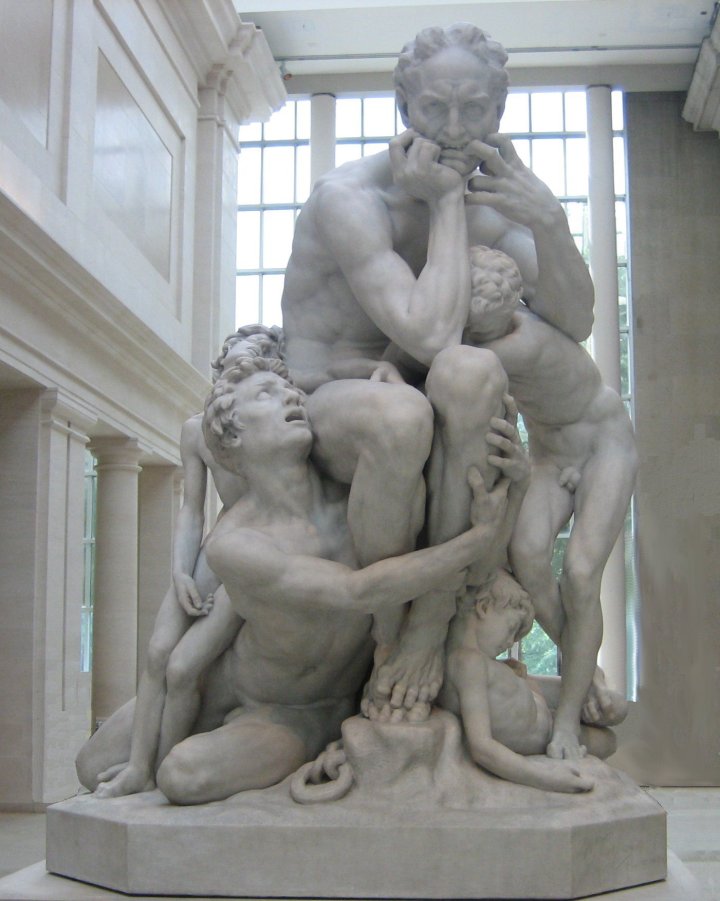
Yet the art itself often also points to a story about time that is different than our prevailing cultural view. Take for instance this statue of Ugolino and His Sons by Jean-Baptiste Carpeaux created from 1865 to 1867.
This work is a visceral depiction of angst and desperation and an incredible technical feat of expert marble sculpting. It also represents a feat of patience and diligence which is rare in our culture today. The work is telling us: “yes it may take you two years of your life to create something this great— it may very well take you a lifetime, and you may be working on a single pinky toe for a decade— but you are taking this time because as an artist, you are attempting to create something that is timeless.”
Sure, there is no art that is literally “timeless”— every human creation is tied to the time in which is was made, and everything material will sooner or later deteriorate, yet somehow I do believe that the attempt to create something timeless is still a worthwhile pursuit. For viewing and creating these works of art does indeed expand our normal sense of time and let’s us touch something meaningful that extends both far into the past and far into the future.
If you are at all inclined, I encourage you to treat yourself to a solo date at your nearest art museum. I am certainly spoiled in that I’m a mere walk away from one of the greatest collections of art in the world, yet I think that any art museum will do. I strongly believe that the act of taking time to appreciate a painting or a sculpture in its every minute detail will make you a better person. The constant motion and rapid pace of our age (especially in a place like New York City) presents you with one hypothesis about time: time is running out! Days, months, years, and lives are short so let’s get to work, and then part hard! YOLO! Yet the art museum presents a different perspective: nothing great is made overnight. Greatness is made through slow, deliberate steps towards your goal. Furthermore, you don’t only live once (YDOLO!)— your physical body will perish, but your great work may live on throughout the ages, being born again and again for each new generation to appreciate and interpret…for to them, it feels like the first time.
Yes I just ended this blog post by jamming in another completely uncalled for Foreigner reference! BOO YA!
On Friday night, I went with a posse of NYU jazz students to Cornelia Street Cafe to hear the brilliant Brazilian Trio of Chico Pinheiro (guitar), Eduardo Belo (bass), and Ari Hoenig (drums)— for the record Ari is not Brazilian, but he is perhaps the most skilled and tasteful drummer I’ve ever seen live. Back in early August, this trio was actually the very first band I saw perform in New York City. On Friday night, just like the time before, the band played with expert skill, incredible taste, and pure joy. They were a delight to listen to and an example of the height of human musical potential. Chico was especially inspiring to me as he seemed to make every note, whether loud, soft, short, or long, sing with musical purpose.
Yet unlike the first time I saw the group, this time a dark cloud hung over my enjoyment of the show. When I heard them play in August, you could likely find me and many others like me laughing confidently about the immanent election of our nation’s first female president. Life was good, our future was safe, and I could listen to beautiful Brazilian jazz free from worry. And yet here we are now. As we all go about trying to enjoy and prosper in our lives, there’s a giant sack of sub-human filth and his band of morally bankrupt mouth-breathers in the Whitehouse launching daily attacks on the Constitution, scientific knowledge, education, human rights, and basic undeniable facts.
As much as I did enjoy the show, I was distracted by the thought that there are much more pressing issues to address than the temporary entertainment of thirty or so erudite jazz lovers in a small bar. This is not meant to be a criticism of the band at all. Each artist has the right to express themselves however they wish; furthermore this trio undoubtedly brings joy to whomever listens to them. I’m pointing more towards a question for myself: what do I want from music? Since arriving here in August, I’ve been practicing hard to attempt to approach even half of the pure musical skill of someone like Chico Pinheiro. And yet ever since the inauguration of our nation’s first orange president, I’ve been yearning to get in touch with music’s more political face. In that spirit I would now like to share with you nine of the great American protest and political songs of the 20th century and today.
There aren’t any recordings of Joe Hill singing his pro-worker songs so we’ll have to rely on this adaptation from Hazel Dickinson. Not to insult your intelligence, but due to the southern twang of this recording, I feel I must clarify that this is certainly not a “rebel girl” in the sense that the confederate flag is called the rebel flag. This rebel girl is someone who is rebelling against the oppressive working conditions in the early 1900s. I’d also just like to say that there is something terribly wrong when America’s president in 2017 has more antiquated views on women and human rights than someone born in 1879.
This was originally a poem and was first recorded as a song by Billie Holiday in 1939. It’s heartbreaking metaphor linking a tree’s fruit to victims of lynching is perhaps still the most stirring and powerful protest song of American racism.
This song has experienced a resurgence lately as numerous artists have played and sung it in protest of Trump’s racist immigration ban. Although the more scathing verses were not originally released, this was a protest song from the beginning.
Musical resistance ran in the Guthrie family. I’m certain you don’t have time to listen to all 18 minutes of young Arlo’s meandering anti-Vietnam War epic, but you should make time.
5. The Revolution Will Not Be Televised— Gil Scott Heron 1971
No the revolution will not be televised, but it will probably hit Twitter.
6. Hurricane—Bob Dylan 1975
Plenty has been written for good reason about his political songs from the early 1960’s, but this song from his 1975 album desire is my personal favorite Bob Dylan protest song. It chronicles the racism towards and wrongful imprisonment of the boxer Rubin “Hurricane” Carter, and it just sounds really great.
7. Fuck Tha Police— NWA 1988
I can’t think of a more direct articulation of the frustration felt by black people after dealing with systemic racism on the part of the police. Unfortunately this song still feels relevant today.
8. Raegan— Killer Mike 2012
Noted Bernie Sanders supporter and rap genius Killer Mike wrote this song eviscerating the policies and legacy of Ronald Raegan. He viciously criticizes the war on drugs, Raeganomics, and Raegan’s foreign policy over an excellent instrumental made by his future Run the Jewels partner El-P.
9. Can’t You Tell— Aimee Mann 2017
This is just one of the many trump protest songs coming out daily. To hear more I’d encourage you to visit 30days30songs.com where the site’s producers have promised to assemble a playlist of 1,000 songs to help us all get through the next four years of “what promises to be a tumultuous and frequently dispiriting and certainly bizarre presidency.” Among new songs from Death Cab for Cutie, The Gorillaz, Mavis Staples/Arcade Fire, CocoRosie, and others, I chose this song from Aimee Mann for it’s emotional depth and because I just love the sound of her voice.
Music is a multiplicity. There is not a single right way to use or experience music. It can provide a sweet escape (hi pop music), mine the depths of harmonic, rhythmic, and melodic possibility (hello jazz), or get you pumped for your intramural basketball game (hey Space Jam soundtrack). It can also give a powerful and infectious voice to the resistance of oppression and injustice. In the dark shadow of the Trump presidency, it is cleansing, empowering, and important to turn on and tune into the righteous voices singing of justice, freedom, and equality for all.
Here at NYU I am exposed daily to some of the most talented and successful musicians in the world. I’ve never been (and likely never will be again) surrounded by such a diverse and eclectic group of true musical masters. By virtue of this, I’m gaining a clearer picture of what it takes to “make it” in the musical world. No, I cannot point to a single factor that will guarantee musical success—anyone who is in the business of reducing success to a single factor is probably trying to sell you something. There are always many unique elements— talent, discipline, luck, influential friends, facial symmetry, instrument choice, era, location, etc.— that may have lead a musician to his or her brand of success. Yet among the multitude of varying success factors, there is one thing that I think all the musical masters have: Love.
That’s right kids, buckle up, because this blog post might get a little sappy.
This seems obvious, but it is worth stating anyway: you have to love music to be successful at music. True, I can’t think of any musician I know who doesn’t love music, but I can think of a lot of musicians (myself included) who sometimes forget about that love because we are distracted by concerns like making money with music, pleasing an audience, or becoming a better musician. There’s certainly nothing wrong with considering those things, but I think it is important that they not cover up the essential fact that we are doing all of this because we just love music.
This semester I have the incredible honor of taking both an improvisation class and a guitar ensemble with the great John Scofield. By all measures John Scofield is one of the greatest and most important living musicians— he is an incredible guitarist and a prolific artist who has recorded and performed alongside jazz legends such as Chet Baker, Miles Davis, Charles Mingus, Herbie Hancock, Jim Hall, Tony Williams, Joe Henderson, and many more. Here is a man who (rightfully) could carry an air of self-importance— and yet what shone through when I met and interacted with him was just a selfless, joyful, and gracious love for music. After a two hour guitar ensemble in which he patiently played arrangements of his songs (at much slower tempos) with me and four other guitarists, he then treated us all to an impromptu rendition of the beautiful standard Days of Wine and Roses. It is clear that he doesn’t think of himself as “the great John Scofield” the way that we do as fans. Instead, he is the great musician that he is because he maintains a deep love for music that pushes him to keep playing, learning, and listening.
On Wednesday I was treated to another lesson in love by the delightful Mary Scott,the widow of the English saxophonist and jazz club owner Ronnie Scott. Ronnie Scott’s Jazz Club opened in 1959 and has been the most important jazz venue in London ever since. In 1964 Mary Scott, an avid lover of jazz, ditched her nursing studies and began working at Ronnie’s, thus beginning a long series of interactions with some of the greatest jazz musicians of all time. She spoke to all of the NYU jazz studies grad students about the onstage power and offstage antics of people like Ben Webster, Chet Baker, Stan Getz, Buddy Rich, Wes Montgomery, and countless others. She told us that when Bill Evans played there you could hear a pin drop in the room because everyone in the audience was listening to the beautiful music with rapt attention. She said that Sonny Rollins would always treat the club staff to an after hours solo concert that would sometimes last until the sun came up. All the while that she was telling us these amazing stories, Mary was glowing with sincere love for the music and musicians.
Again, there are countless reasons that Mary Scott and John Scofield have gotten to live the incredible lives that they’ve lived. You cannot discount the luck of simply being at the right place at the right time. Yet John and Mary’s experiences couldn’t have happened to just anyone. A fundamental reason that John Scofield has gotten to perform and record with brilliant musicians and that Mary Scott has gotten to hear them and know them personally, is that each has a deep devoted love for the music.
A lot of things need to go right for you to be success in anything. I can’t tell you what the right conditions are for you to become a famous musician, or a well known author, or a brilliant inventor— I’ll leave it to Malcom Gladwell to tease all of those out. However (no matter how corny it sounds) I do know one thing: you have to have love.
I’m proud to say that I took a trip to Washington DC last weekend to participate in the historically huge Women’s March on Washington. Unfortunately, my whole trip was a near perfect demonstration of Murphy’s law. The most flagrant tragedy of the weekend was obviously that a fleshy orange sack of unchecked ego was sworn in as our nation’s 45th president, yet my personal experience of the weekend also included setback after setback.
My original plan was that I would hitch a ride to Maryland with my friends Jonathan and Tina (who were also going to the march), take the train into DC to stay with another friend Friday night, and then go to the march on Saturday morning. We did depart on Friday afternoon, yet what Google maps claimed would only be a four hour drive ended up taking closer to seven and a half as we travelled among thick unrelenting traffic. Thus, I called my friend in DC and told her that I was going to get in too late and decided to just sleep on the floor of Jon and Tina’s hotel room.
After the long journey Jon and I desperately desired some beer in our bloodstream so we walked to a nearby gas station only to discover that in College Park, Maryland, you cannot buy beer in gas stations. So we then drove down the street to a bar (aptly named “Bar”) and settled in to some stools next to the locals. The first thing that happened was that we witnessed a drunk man in a powder blue sweatpants and hoodie getup being kicked out of the bar for pouring extra booze into his drinks from a flask in his pocket; the second thing that happened was that we were ignored by the bartenders for a solid ten minutes before we got to order our drinks; and the third was that our conversations was hijacked by a man spouting the conspiracy theory that Donald Trump was hypnotizing the populous with those weird hand movements he does.
The next morning, we drove down to the train station, parked a block away in a seemingly pleasant little neighborhood (Jon described it as “where your grandma would live”), and then took our place at the back of what I’m certain I can accurately describe as the longest line in the history of College Park, Maryland. We waited in line for roughly and hour and a half before we finally reached the machines that were dispensing metro cards. Go figure, as soon as I got to it, my machine decided it didn’t want to print metro cards anymore. Thus, I had to merge into another line and wait just a little longer before getting my card.
We finally packed ourselves into a train full of fellow marchers and made the trip into the heart of DC. We didn’t make it in time to hear the many wonderful speakers at the event, but we did get to march, chant, and wear ourselves out for a just and beautiful cause. Around 5pm we boarded another train and began our return journey and we were two stops away from our destination when the train suddenly stopped, broken. Everyone on the train waited helplessly, packed shoulder to shoulder for over an hour before another train came to slowly push us back to the previous stop. We finally boarded another train and made it back to good ole College Park, Maryland around 8pm, still anticipating a long drive back to NYC. We wandered back to the car and discovered that the back right window was smashed. Jonathan’s and my bags, each containing our laptops, were stolen.
Like I say, it was a near perfect display of Murphy’s law. Near perfect, but not perfect, because there was one glaring exception to the rule: The Women’s March was an unequivocal success. In DC and across the nation, people engaged in what was likely the largest demonstration in US history— a demonstration that despite it’s size and fervor incited no violence, and required no arrests. I was in awe of the sight of the seemingly endless sea of people marching past the Capital and the White House and on to the national mall, and invigorated by the energy that ran through the entire crowd. Every fifteen minutes or so I would hear a distant swell of jubilant screams that grew louder and louder until it swept over our portion of the march in a continuous wave. It was incredibly inspiring to come together in solidarity with so many people and affirm our belief in human rights for all people. For this was not so much a march against a truly despicable man, but a march for the rights of the historically disenfranchised. Sure, there were plenty of anti-trump chants (my favorite being “he’s orange, he’s gross, he did not win the popular vote”), yet there were just as many simply affirming basic rights (“My body, my choice! Her body, her choice!”) or basic tenets of American democracy (“Tell me what democracy looks like! This is what democracy looks like!”).
I do hope that we the people never again have such a dark reason to show up by the hundred thousands and affirm our belief in basic human rights, yet it was an incredible moment, a beautiful sight to see, and I felt extremely lucky to be there. The silver lining of electing a grotesque, sexist, xenophobic, neo-fascist, climate-change denying, cartoon super-villain as our president is that a massive number of American citizens now feel inspired to do things like call their senators, protest, and engage in civil-disobedience (parts of democracy that I and many others overlooked during Obama’s presidency). For all of the evil actions that Trump is going to attempt, I hope that there will continue to be equal and opposite reactions from the millions of people in the United States that truly believe that “all [people] are created equal, that they are endowed by their Creator with certain unalienable rights, (and) that among these are Life, Liberty, and the Pursuit of Happiness.”
I spent the majority of my waking hours last weekend either sitting in a car, creeping along in bumper to bumper traffic, standing in a line, or packed shoulder to shoulder with strangers on a train. I also had my favorite bag, some of my clothes, my journal, a book, and my laptop stolen. And yet if I were given the chance to do it all again, I absolutely would. All of that was a small price to pay to witness and take part in the beautiful, historic, and life-affirming moment that was the Women’s March on Washington. Let us all continue to fight the good fight.
After a month long hiatus, I’m back to blogging. In the past, after having taken a long break from blog writing, I’ve always come back to it with some grand declaration and a clear goal to enact (e.g. I’ll blog everyday, release a song every week, etc…), and I am tempted to do this yet again. We are after all still within the window of opportunity for me to tell you all about my multiple new year’s resolutions! I’ve asked around, and it seems like most of my friends are not as enthusiastic about the idea of new year’s resolutions as I am. Personally, I love to make resolutions. It feels great to set big goals, and dream of what my life will look like when I’m living as my peak self.
I’m also certain I could squeeze out a whole blog post simply by talking about the what, why and how of my new year’s resolutions. I’d feel great about myself and all my ambitious plans, and yet you the reader might actually feel a little bit worse. The best case scenario is that you’d get bored and just stop reading. The worst case is that you would think “Wow, Lucas sure is going to do some awfully cool stuff this year! What am I going to do? Not much. I suck. I hate myself. You know what, I hate Lucas too.” Look, I don’t want you to hate yourself, and I especially don’t want you to hate me, so instead of talking about all of my goals and (hypothetical) future achievements, I’m going to try the opposite approach and talk about some of my past shortcomings. Because a little dose of schadenfreude does a body good— it’s my New Year’s gift to you! You’re welcome.
For as long as I can remember, I’ve carried two (mostly subconscious) desires that have motivated much of my behavior: the desire to be liked, and the desire to be the best. In many ways, these desires have served me well in my life. I think I’ve generally behaved in a well-mannered, somewhat delightful way, and a lot of people have liked me because of this (or in the least, they’ve not disliked me). Additionally, I’ve put a lot of effort into being really good at things like music, sports, and school, and as a result I’ve been a relatively high achiever in these fields. And yet, for the past decade or so, as I’ve sought to create, sustain, and grow a vibrant musical life, I’ve discovered that these motivating desires have provided more hindrance than help.
Consider this: one of the best ways (if not the very best way) to improve at playing music, is to play with musicians who are better than you. Here at NYU, and in New York City as a whole, I am surrounded by musicians who are more experienced than me. I have ample opportunity to play with them in both impromptu and organized jam sessions all over town. And yet last semester, I consistently avoided these opportunities, because I have this desire to be one of the best in whatever realm I enter and it feels very uncomfortable for me to be one of the very worst. But if I really am serious about improving as a musician, I’ll quit ego-tripping right now and start getting comfortable with playing with people who are far better than me.
Ultimately I also wish to compose my own music and release it in to the world, and it would be a dream come true if I could earn a living by writing original music. Although it is a relatively rare livelihood, I don’t even think it is all that far-fetched. I know that I can write music that sounds pretty good, and I see numerous outlets for original music: movies, TV shows, video games, advertisements, live performances, or sold directly to an audience (who knows, maybe even old-school aristocratic patronage will come back into fashion). Yet success in any of these realms requires at least one common thread: the willingness to put my music out into the world. Sure, I’ve done this on a small scale— I’ve written some original songs, made some home recordings, and put them up on sound cloud. That counts right? No, not really. The stakes are too low. I’ll never truly know if people like it or dislike it, and that is the hurdle that I am hesitant to jump over. For I have this crippling desire to be well-liked and approved of, and I am afraid that if I put my music out into the world and really try to sell it, people just won’t like it. Yet the fact is, no matter what, some people will not like my music. It’s impossible to write universally loved music— go ahead and try; you’ll end up writing elevator music. If I really am serious about making music my livelihood, I’ll accept that many people are not going to like my music, and just put it out into the world anyway.
Yes, I’m a scared little piglet everybody— I’m afraid of not being the best and I’m afraid of not being liked. Yet I have some virtues as well. In the least, I have an awareness of my fears, and the gall to confess them to you all. I’ve shared these shortcomings with you because I want to move beyond them. As Louis Brandeis said—guys, wait, listen, I’m not going to act like I knew who Louis Brandeis was before I wrote this, I was just vaguely aware of this quote and so I looked up who said it. Anyway, as Louis Brandeis said, “publicity is justly commended as a remedy for social and industrial diseases. Sunlight is said to be the best of disinfectants.” Well, this blog is my publicity, and you readers are the sunlight, here to help me clean up my act. Thanks for reading.
So a couple of months ago I was waiting on the C train listening to an old man play what sounded to me like Bach on his electric piano. Despite his lowly stage and modest pay, he was playing beautifully and so I looked around to see if any of the other awaiting subway riders were noticing his performance. To my delight I looked up and saw one young woman listening with rapt attention. After dropping a couple of dollars in his keyboard case, I boarded the train and ended up standing right next to that woman. So I did what few New Yorkers ever do, and I struck up a conversation with a stranger on the train. I asked her if she was a musician, and she said no but that music was a big part of her life and that she was actually involved in film (acting, writing, directing, producing, etc…). We chatted about a short film she was producing and eventually I told her that if she ever needed anyone to score her films, that she should call me. I gave her my card, bid her adieu, and got off at my stop, satisfied with the exchange, but not exactly expecting anything to come from it.
Well, I must have made a good impression (either that or she couldn’t resist the low, low price I promised her), because a few weeks later, she called me about scoring the short film that she was producing. Sidenote: kids, it turns out you should definitely talk to strangers, because they’ll end up hiring you to score their films. So for her privacy and my own entertainment I’m going use a completely made up name and call this producer Lilliandra (I estimate there’s an 85 percent chance Lilliandra is going to read this blog, so I hope you enjoy your made up name, Lilliandra). Lilliandra was working alongside the writer/director/star of the film— let’s call her Nira— to put the finishing touches on the work. The film is a comedy with a surprising dramatic turn set at a low-key house party in Greenpoint, Brooklyn. Both Nira and Lilliandra admitted that there are some editing issues, and some suspect acting on the part of one of Nira’s costars, yet overall I found the film charming, funny, and heartfelt, and Nira shines as a magnetic personality onscreen (off-screen as well in fact). I was happy to be a part of the project, and after some direction from Nira and Lilliandra, I began writing and recording the music for the film. After a week of hard work I had something I was excited to show them, so we set up a meeting at Nira’s Greenpoint apartment.
Yet after showing them my work, I could already see the unfortunate truth on their faces: the music was not right. In a nutshell, the music stepped on the humorous parts and over-dramatized the dramatic parts. Despite the fact that Nira and Lilliandra let me know this very delicately, I’m ashamed to admit that internally I felt very defensive. I thought “didn’t they know how much work I had done… and this music is really good…and I’m giving them a low, low price so they should be happy with what I gave them… etc.” Yet all of this was simply the ego-trip of a rookie film composer faced for the first time with some real life critique of his work. If I am going to continue in this business (which I certainly hope to), I need to grow thicker skin and be perpetually open to direction, critique, and even outright rejection. Lilliandra and Nira were right after all— I had stepped on the jokes, and over-dramatized the drama.
Ultimately, however, I was guilty of something more egregious than simply writing bad music. I had essentially used this film as a forum to show off my abilities as a composer, rather than simply trying to help tell the story. The music was in fact “good” in the sense that it was well crafted and sounded nice, but it was the wrong music for this film. Nira and Lilliandra were going for something more nuanced than what I had presented. My music was outshining the film at the expense of the story.
Likely most of us at one point or other have been guilty of bolstering ourselves at the expense of the larger community or project that we are a part of. In the least we’ve all seen it in the losing basketball team with a selfish “all-star” taking all the shots (I’m looking at you 2015 Kobe Bryant), or the band with lazy songwriting that simply serves as a forum for the lead guitarist to shred painfully long solos (I’m looking at you jam-band scene). Yet the best and longest lasting actors, musicians, athletes or workers in any field are not those who do everything to make themselves look better, but those who realize that they are a part of a bigger picture and simply play their part very well (I’m looking at and applauding you Dustin Hoffman, Dennis Rodman, Steven Drozd, and everyone of their ilk).
Last night I met again with Lilliandra and Nira. I had made many adjustments according to the direction they gave me, and as a result the film’s story and personality was much more clear than it had been in the previous incarnation. We had a pleasant and productive session of simply fine-tuning the musical elements, rather than having to completely re-work them. The night was fun and fruitful because we were all on the same page, telling the same story, and each playing our part.




 Lucas Murray Music