lucbraddeb

Last night at the Afterthought I watched the Good Time Ramblers play for over four hours to a packed room of familiar faces. Around midnight we all raised our glasses in honor of the bar, around 1am we all danced to the final song, and around 2am Jeff Jackson announced the (truly) last call. It was a bittersweet goodbye to that quirky little corner spot that has seen thousands of performances from both musical giants and local heroes since the late 70’s. The Afterthought meant a great deal to me personally— I’ve been going to hear music there since I was in high school (this was before the 21 and up rule was imposed for all shows at the Afterthought), and in my young musical career I’ve performed there far more than any other venue. The Afterthought’s closing has been hard for me to handle, and for that reason I want to walk myself through the five stages of grief (Denial, Anger, Bargaining, Depression, and Acceptance) for the Afterthought. (Note: I do realize that in real life you can’t just walk through the stages of grief in one day, but this isn’t real life, this is my blog and I get to do what I want)

1. Denial

Last week I heard about the Afterthought closing by reading my friend Olivia’s Facebook post. I played guitar at the Afterthought every Sunday for two years and I hadn’t been told about the Afterthought closing, so my first reaction was indeed denial: She doesn’t know what she was talking about! She doesn’t work there! What does she know! That can’t be true. Even as all the facts of The Afterthought’s closing surfaced, I still went to play brunch on Sunday and treated it just like any other Sunday. Though it was indeed my last Sunday brunch performance at the Afterthought, I didn’t do any special song or send off, I just played and went home like I always do. I didn’t want to acknowledge that it was happening.

2. Anger

The most enraging fact in this whole saga is that I and all of the other performers/employees at the Afterthought were given so little notice about it closing. I was initially angry at the Afterthought’s manager, because I mistakenly believed it was him who had not informed everyone. I can’t apologize enough to Richard Muse for even thinking this— I’ve seen and experienced firsthand how much he cares about the Afterthought and all of the employees, and Richard was in fact given the same short notice as the rest of us. The truth is, the new buyer of the Afterthought is shutting it down for renovations and from what I understand it was he who gave only about a week of notice to everyone working at the Afterthought. It is an enraging injustice that some good, hardworking people are without jobs today because they were not given enough time or notice to find new work before the Afterthought closed. My outrage is amplified by the thought of who the new buyer is. You can look up who that is on your own, I don’t want to mention the name in my blog, but here are some clues: they already turned one long-standing cozy Hillcrest spot into a soulless hipster laptop hell, their coffee tastes terrible, and they make a real good sandwich.

3. Bargaining

Hey Stephanos, sorry about what I said just now about Mylo’s Coffee Co. I didn’t mean it—I’m just upset. Will you just promise to keep the music alive at the Afterthought? I’ll be totally on your side, I’ll put ads up for you on my website, I’ll drink your coffee everyday! Just please keep booking local bands (like mine) to play in that wonderful space. Please!

Ok readers, let me pause for a second and tell you some truth. I’m a bit hungover right now. I had a few too many drinks in honor of the Afterthought last night— what can I say, I love that place. I have some important things I want to say concerning the final two stages of grief about the Afterthought’s closing, but I don’t think I can express those thoughts right now. Instead of over-extending my foggy brain, I’m going to do myself and you readers a favor and make this a two part blog post. Stay tuned next week for Depression and Acceptance! Is this a cop out? Yes. Do I care? No.

For those not yet privy to it, this blog is part of a nine-month long project in which I release a blog-post and a new song every week. So below is this week’s Opus if you care to listen, and even further below are links to posts from past weeks. Enjoy!

Week 1—Nine Months of New MusicWeek 2—That’s Masturbation

Week 3—Oblique Strategies

Week 4—A Conversation with the Wolfman

Week 5—Turn Off the Music

Week 6—Thoughts on Prince

UNITED STATES - SEPTEMBER 13:  RITZ CLUB  Photo of PRINCE, Prince performing on stage - Purple Rain Tour  (Photo by Richard E. Aaron/Redferns)

Let me preface this post by saying that I am not a Prince super-fan. I think he was an amazing musician, a distinguished songwriter, and a delightfully freaky performer. But truthfully I’ve only ever owned about four Prince albums (a drop in the bucket considering his massive discography), and would actively listen to them only once or twice a year. Prince’s passing has forced him into my consciousness and yours in a way that unfortunately nothing else could. Traveling from Little Rock to Eureka Springs (and back again) this past weekend, I had a blast listening to nothing but satellite radio’s Prince tribute station, and during these seven hours of Prince I thought a lot about his life, his image, his fans, and his music. I do recognize that there is seemingly no pressing need for me to throw my opinions into the endless pile of articles, blog posts, and tweets about Prince circulating through the internet, and I would not fault you if you decided to just listen to Purple Rain instead of reading this. But I feel compelled to talk about the Purple One because there are some things that need reiteration, there are some things I haven’t heard anyone else say, and there are some things that I have heard people say that I flat out disagree with. So here are seven thoughts on that peculiar and mysterious little rockstar we loved so much.

  1. While listening to the Prince tribute radio station, I heard a couple of soundbites from fans who had called in and stated that part of the reason Prince’s death is so tragic is that “there will never be that caliber of musician again” and that “musical artists today are not as good as Prince”— You’ll also see this sentiment echoing around the internet in numerous articles that claim that this 2016 is “the year that music died” (with legends like David Bowie, Merle Haggard, Glen Frey, George Martin, Maurice White, Phife Dawg, Prince and others all passing away). This is undoubtedly not true. Genius and true inspiration are certainly rare in music (as in any field), but also relatively consistent. Let’s not give up on music just because some of our favorite icons have passed away. Some people were likely making the same distressed cries about music being dead, and the loathsome state of current music back in August of 1977 after Elvis passed away, and then guess what: 8 months later Prince released his first album. Prince was a superlative talent and a true original and likely there will never be anyone else quite like him, yet it is a fallacy to think that there will not be new inspired creators to sing the songs of our time, win over our hearts, and make us party like it’s 1999.
  2. Prince was Prince’s real name. His full name was Prince Rogers Nelson. You probably know this by now—I’m not trying to insult your intelligence— I just want to point out that Prince is a really cool name. I might name my son Prince. Or maybe Duke, or Earl…
  3. I love so many Prince songs, too many to name, but there are also a great many Prince songs that I don’t love. This is not a knock against Prince, it is simply a by product of the shear volume of work that he released. Prince released 39 studio albums and he allegedly has enough work in his vault to posthumously release over 39 more. Prince incessantly experimented with new sounds and songs throughout his career, and indeed some of these experiments fell flat. Even great creative geniuses produce sub-par work some of the time—this his does not diminish their genius. Indeed it was Prince’s willingness to experiment, take risks, and fail that allowed him to not only produce hit songs, but to create era-defining sounds that will be imitated for decades to come.
  4. Prince boasted “there’s no particular sign I’m more compatible with,” but as a Gemini (born on June 7th, 1958) he was in fact generally more compatible with Sagittarius, Libra, Leo, and Aries.
  5. I don’t know what Prince’s life was really like and unless you were his close friend or family member you don’t either. What we saw was the celebrity—the image. We saw what Prince let us see, and he certainly didn’t let us see everything. By many accounts from people who knew him, Prince was a warm, genuine, and generous man, and I truly believe that he was a wonderful person. But it is important for me to also recognize that I did not know Prince the man. While most of us are mourning the loss of an icon, some are tragically mourning the loss of Prince as a friend and a family member.
  6. There are a great many things that might seem strange to you about Prince: his androgynous appearance, his genre-bending songs, his subversion of gender stereotypes, his secretive personal life, his religious sect, his many aliases, or anything else you want to name… Yet the most unusual thing about Prince is that he was incredibly famous. There are a great many people who seem weird or different (by the way if you ostracize those people, that’s your shortcoming and not theirs), but there are only a tiny handful people that that are a household name all over the world. That’s the strangest thing about Prince.
  7. The author Chuck Klosterman wrote a book called Killing Yourself to Live in which he argued and demonstrated that the best possible career move a famous musician can make is to die. It is certainly true that since his passing Prince has been the subject of innumerable news stories and sold an enormous amount of music (he reportedly sold one million songs and 231 thousand albums the day after he died). I admit that I’ve listened to more Prince songs in the past few weeks than I have in the past few years combined! We often appreciate someone more when they are no longer around— this is natural. Yet I hope that we can all recognize that we don’t have to wait until something is gone to appreciate it. Look to the living musicians, artists, writers, artists, and people in your life that you most care about; go see them in concert, write them a letter, take them to dinner, give them a hug— express your love and appreciation while they are here to receive it.


    For those not yet privy to it, this blog is part of a nine-month long project in which I release a blog-post and a new song every week. So below is this week’s Opus if you care to listen, and even further below are links to posts from past weeks. Enjoy!


    Week 1—Nine Months of New MusicWeek 2—That’s Masturbation

    Week 3—Oblique Strategies

    Week 4—A Conversation with the Wolfman

    Week 5—Turn Off the Music

IMG_0648

Music is everywhere. No I’m not talking about the song of the birds, or the gentle hum of the breeze—I’m not being poetic. I’m talking about that REO Speedwagon song playing at the gas station, or Tears for Fears at the grocery store, or the Spoon album playing at the coffee shop while I’m writing this blog post, or me tuning out the Spoon album at the coffee shop with some Lamont Dozier in my headphones. With only a few rare exceptions, it appears that where there are people, there is music playing. This is great right? I love music, you love music, so it is only natural that we would want it playing everywhere.

No, this is not great. First of all, music is often playing at the supermarket, and liquor store, and restaurants to make you spend more money— this isn’t a conspiracy theory, the effects of music on purchases have been studied, tested, and verified since the 1960s (here’s a layperson-friendly article on the topic if you care to read it). The fact that corporations are using music to affect our purchase habits is certainly alarming. Yet as a musician and lover of music, I am disturbed by a more general fact: when music is playing constantly, we tend to value it less.

Music is perhaps the single richest human endeavor. Interchangeably or all-at-once music can provide a means of communication, an expression of emotion, a spiritual devotion, an ecstatic experience,an affirmation of one’s culture or group, a catharsis, a way of healing or countless other things. Music activates neurons in more areas of your brain than almost any other activity (and that’s a nearly un-paraphrased sentence from this article). Music should be revered for the all-consuming entity that it is. Instead we offer it up like free mints at the end of a Tex-Mex meal.

Before the proliferation of recorded music and stereo systems,respect for music came more naturally. To experience music a person would go to church and hear the mighty organ and choir, or go to the symphony, or meet in the town square for an after-work jam, or listen to a family member play piano, or sing songs with your friends (I”m certain that this is an over-simplification of musical activities in the past but you get my drift). Music was the most captivating form of entertainment and a relatively rare treat by today’s standards. Today we have constant access to music through computers, smartphones, radios and stereos and many of us wield this power like drunken kings, constantly bombarding our ears with a schizophrenic onslaught of tunes.

Furthermore, I think that there is a direct correlation between the ubiquity of music and a decline in dancing. In some African languages the word for “music” and “dance” is the same. In American English, perhaps we could use the same word for “music” and “driving.” Today music turns up in places that are not appropriate for dancing just as often as places where dancing is encouraged. There is probably some up-tempo music playing at the grocery store right now, but you won’t see anyone dancing to it. This socially forced denial of dancing carries over even to places that are deemed appropriate for dancing. I’ve been to (or performed at) too many live shows where the band is laying down some clearly danceable grooves, and the crowd is just motionless, cerebrally listening. I think that this is just what happens when you’ve been listening to music all day but haven’t busted a single move— you didn’t dance during the day when you were listening to Beyonce so why break the seal at the Big Piph & Tomorrow Maybe show? (shameless plug number one)

However, there is still hope for music. One arena in which music is still respected and fully enjoyed in our culture is at weddings. During the ceremony, music propels the movement of this still sacred ritual, and people are quite often moved to tears when they hear the first notes of the bride’s processional. Even after the ceremony, music still sits on it’s rightful throne; through some magical combination of booze, feel good songs, and joy for the newlyweds, wedding receptions still manage to get people to really cut loose on the dance floor. I absolutely love weddings for this reason, and I am extremely excited to get to travel to Eureka Springs this Saturday to play at a wedding reception with my band That Arkansas Weather— we’re available for hire by the way (shameless plug number two).

Yet you don’t have to wait for a wedding to start respecting music. Unfortunately you can’t turn off the music at the grocery store or Starbucks, but you can turn it off in your car; and you can take your headphones out once in a while; and you can turn it on in your room and really let it grab you by the bones; and you can come to the That Arkansas Weather show Friday at the Afterthought and dance til you feel better (shameless plug number three and I’m out).

For those not yet privy to it, this blog is part of a nine-month long project in which I release a blog-post and a new song every week. So below is this week’s Opus if you care to listen, and even further below are links to posts from past weeks. Enjoy!

Week 1—Nine Months of New Music

Week 2—That’s Masturbation

Week 3—Oblique Strategies

Week 4—A Conversation with the Wolfman


JasoninStudio

I admit that today’s blog-post is a bit longer than normal (that’s only because it’s a lot more interesting than normal). So if you’re simply looking to hear this week’s song, you can click this link right here. But you have to promise me that you’ll go back and read the post. Promise? Ok, go ahead you can click it.

Today marks the fourth week of my nine month long endeavor to release a song recording and a blog-post every week. As I explained in the first weekly blog-post, my primary goal for this project is to produce a large quantity of work, yet my underlying hope is that I will happen to create some good quality work along the way as well. Yet quality songs are hard to come by. Assuming that I have written a good song (which is certainly not a safe assumption), there is still the problem of making the recording of the song sound good. I use a recording software called Logic 9, and with it I have more ease of control, more effects, and more tracks at my disposal than George Martin and The Beatles could ever dream of, but I have an extremely limited understanding of how to use all this power. My knowledge of the recording process comes solely from me tinkering around with various recording devices and software and watching a few youtube videos. When I am recording, I typically have a vague sense that I am doing something wrong, and sometimes when I make something that sounds good, it feels a lot like luck.

So instead of subjecting you readers/listeners to weeks and weeks of poor quality recordings, I decided to try to learn a thing or two this week from my ole buddy Jason Tedford. Jason is the sole owner and operator of Wolfman Studios where he records musicians and bands in all genres and all walks of musical life. He also plays guitar for the riotous rock band Iron Tongue and is a co-owner of the brand new music shop Dogtown Sound in North Little Rock. I got to know Jason during our stint together in the band The See, and he has always impressed me as someone who is extremely kind, humble, genuine, talented, and incredibly knowledgeable about music, recording, and Star Wars. So for the small price of one Gyro Platter, Jason agreed to meet up with me Monday at Leo’s and let me pick his powerful brain. Below is an abridged transcription of our conversation— if you want to delve deeper into more technical side of our conversation, feel free to send me a message and I’d be happy to share. Enjoy!

L: Jason, this is just so the people can get to know you a little bit. You are probably the biggest Star Wars fan I know, but who are you in Star Wars?

J: Han Solo. Who else would I want to be? Han Solo.

L: I mean that’s a pretty bold claim, we’re talking about the whole star wars universe— most of us probably aren’t Luke, or Han, or Leia, or even Jar Jar— we’re probably just some dude sitting at the cantina.

J: Ok I can say I want to be Han Solo. That for sure. Whether I am him or not… I mean I don’t know, I’m a bit of a scruffy looking nerf herder. So I think I got that. Scoundrel a bit. I think I got that. He’s very anti-establishment. He’s a nonconformist. He sums me up pretty well. He’s definitely who I want to be, and he’s definitely who I’m most like. I mean I do have this (points to his millennium falcon tattoo).

L: Ok, I’ll give it to you. Here’s another Star Wars question, where does The Force Awakens rank against all the Star Wars films?

J: I’d say it’s a tie for third. First is New Hope— I saw it when I was six and it was a huge thing for me, now is Empire a better movie? Probably, but there would be no Empire without a New Hope. So second is Empire Strikes back. Third, is a tie between Jedi and Force Awakens. And then if you’re going to add the prequels in the’ll be ranked in reverse order: It’s gonna be, revenge of the Sith, Attack of the Clones, and if we have to put it in there, Phantom Menace last.

L: Ok now that we’ve gotten that out of the way, we can start talking music. So you both play in bands, and record them. Which do you identify yourself as more, musician or recording engineer?

J: Oh I think I definitely identify as a recording engineer/audio nerd, more than anything else. There have been times when I’ve gone years without being in a band, that I’ve always had the studio going on.

L: Did you start playing first? Or did you start recording first?

J:I started playing first… Well… that might not be totally true. Because when I was a little kid, I would spend hours at my grandmother’s house playing on this cassette deck doing all sorts of radio shows— all sorts of crazy stuff. And ya know, going through high school, I mean even when I was playing guitar, I had cassette decks chained together trying to record something. I didn’t really understand the concept of being a recording engineer. I didn’t even realize that was a job until I was in my first band and recording for the first time.

L: And what band was that?

J: Well it I guess it wasn’t my first band, but it was the first band I was in that actually recorded. It was a band called Pseudo Hippie, and it was all the same people who were in Ashtray Babyhead. It was like an early 90’s grunge band, we sounded like we came right out of Seattle!

L: Cool, cool, cool…

J: Eh, I don’t know if it was that cool. Haha! But we recorded, and it wasn’t real good—it was in a not great studio, but I was like “wow this is fascinating!”— this whole process ya know? And it really kinda grabbed me at that point. But it wasn’t really until the next band that I was in— which was called Marigold and we wen’t to record with Barry Poynter, at his studio which was then still at his parent’s house, and we’re recording with this dude and he has a console on a pool table and he’s tracking drums in the sun room, and we’re like “this sounds amazing” — that’s when it dawned on me “hell, I could do this!” I bought my first four track probably weeks after recording with him and was tracking stuff in my house, and that’s when it all started for me.

L: So jumping forward quite a bit, what are some of your favorite bands that you’ve recorded to date?

J: The Becoming Elephants record was a lot of fun to do— those guys are just incredible musicians. The See record was a personal accomplishment, I was really proud of The See record. The Collin vs. Adam record was really really fun and good. Who else… That’s it. Haha! No. I’m always recording with this guy Drew DeFrance— hard to say I like a particular album because he just does a ton of stuff. He’s really great to record with. They’ve got a full band now, and they’re all really good solid work your ass off players. Who else, Brian Nahlen is always really fun to work with. He’s great, writes great songs, great singer, and he’s got really great ears. Piph is really great to work with— he’s a pro.

L: And do you record using Tape or Digital? And is one better than the other in your mind?

J: I use digital. I used to have tape, but I don’t have it anymore— I mean it’s sitting in a closet, because it’s just too hard to mess with, and it’s not the type of tape that people are looking for. People are looking for 2 inch tape—16 or 24 track whatever— because it sounds better.

L: It sounds better than digital?

J: Well, two inch tape sounds better than the half inch tape that I was running. Two inch tape vs. digital? They both sound good. It’s really more of an opinion. I think that certain things sound better on tape— I think drums and bass guitar. Guitars can sound good on anything. But I think with a lot less work you can make things on tape sound a little bit punchier and a little more real and have some grain to it that is really fun and interesting, whereas you have to literally create that on the digital side.

L: Can you do that? Can you fool somebody with digital into thinking that they’re listening to tape?

J: You can. But the fact that you’ve got 90 percent or more of the population listening to music as MP3’s on their phones or streaming off of Spotify, I don’t know if it even matters anymore! Hahaha! You can listen to something and go “oh, that has a nice warm, punchy kind of feel to it” — that could have been done with tape or it could have been done with digital. I think some people, depending on the medium that they’re listening to—whether it’s vinyl, or CD, or MP3, and depending on the speakers and where they’re listening— maybe they can tell a difference; maybe they can have a preference. I don’t think it matters anymore. The funny thing, is that it’s all going to be digitized at one point or another.

L: When you listen to music, how do you listen to it— what medium do you use?

J: Usually it’s off of CD. Usually it has been ripped onto my iPod, but at full range. I don’t mess with MP3’s— I’ve got friends who are like “I’ve got 50,000 songs on this iPod of mine” and I’m like “yeah, but they’re all MP3’s, and I’d rather have 5,000 songs that sound good, than 50,0000 songs that sound bad.” I mean there aren’t 5,000 songs I’m going to listen to anyway! So that’s what I usually listen to, in my house or in my car. In my house either with my studio monitors, or in my room with my vintage Klipsch Heresy speakers.

L: So here’s a technical question. What are you referring to when you say “full range” as opposed to MP3?

J: Well an MP3 is a compressed audio file. CD’s are generally 44.1 (kHz) sampling rate, 16-bit audio files. When I’m ripping a CD into iTunes I’m ripping it in at that same resolution. It makes your file size 10 times better, but it sounds as good as it does on CD.

—At this point, Jason launched into a long and fascinating technical explanation of the sampling rates he uses during his tracking, and mixing process in the studio. I learned a lot, but I had to stop him to insist that he take a bite of his Gyro—

L: Ok so before we wrap up, I want you to try to ruin one of my songs for the public. I want you to listen to it, and tell me what’s wrong with the recording. This song is called Jesus Burger.

J: It’s kind of Beatlesy! But are you tracking any of this stuff as MP3’s?

L: This is an MP3!

J:Oh yeah I can tell… It’s very 60’s. It’s good. I like it. But I could tell it’s an MP3 right off the bat. I could definitely hear the phaseyness and the weirdness about it. The drums are a little hard to kind of distinguish, at first you can hear them and then as it goes on they kind of get muddied up in the mix. If they were a little more defined, I could probably feel the rhythm a little better. It might be an EQ thing— usually a lot of your muddier frequencies are in the low-mids, and sometimes dipping some of that out can give you a little clarity. The vocals are a little on the thin side— which may be that you are using a dynamic mic. If you got a condenser mic, that might be better. Your voice is a little on the higher side, and you’re singing throughout it, rather than screaming like some guys do. I feel like a condenser would be better for your voice. A condenser will be a lot clearer and more flattering for your voice and might sit in the mix better. We could make a great song out of that.

Thank you Jason for sitting down and talking to me! It was a totally fun and educational experience. I’m going out to Dogtown Sound now to buy a condenser mic to help make my dainty vocals a little thicker and creamier. For now, here’s another Opus recorded without the help of a condenser mic. Enjoy!

This post is part of a nine month project in which I am releasing a new song and blog post every week. If you want to get caught up, here are the links to the previous entries:

Nine Months of New Music— Opus 1

That’s Masturbation—Opus 2

Oblique Strategies—Opus 3

OwnIDeas

Here’s your “no shit sherlock” statement of the day: the hardest part of creating something is figuring out what to do next. Sure, one or two lines of your song (or book, or poem) might come easy. Inspiration hits and you have a great idea: “I’m starting with the man in the mirror.” Ok Michael Jackson, great start, but what are you going to do now?— Oh I don’t know Lucas, perhaps I might write the most wholesomely uplifting pop song of all time! So truthfully it was Siedah Garrett and Glen Ballard who wrote that song, but you don’t know who those people are so I pretended for a second it was actually Michael who wrote it. April fools. Regardless, for those of us who are not artistic savants, fleshing out an inspiring idea is an extremely difficult process, plagued constantly by the question: what do I do next?

It’s very easy to feel blocked or puzzled during the creative process. Yet I believe that this feeling most often is the result of thinking too much. I believe that creation is an action, not a thought. Repeat: Creation is an action, not a thought. My personal favorite tool for getting out of my head and into the act of creation is called Oblique Strategies by Brian Eno and Peter Schmidt.

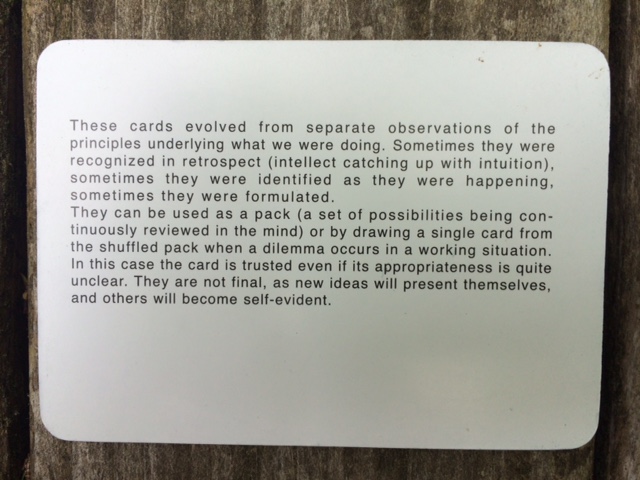
You’ll remember Brian Eno as member of the early 70’s glam rock band Roxy Music, as a successful solo pop artist, as the most prominent pioneer of ambient music, as a producer of bands such as the Talking Heads, U2, and Devo, as the composer of the sounds for Windows 95, as an experimental visual artist, and from countless other projects and collaborations. There is a reason Eno has been so prolific and relevant throughout his decades long career. He (similar to Davids Byrne and Bowie) did not settle in to his original pop-star sound, but simply fell in love with the process of creation, leading him to diverse edges of the music and art world. His buddy Peter Schmidt is a modern artist, painter, and theoretician who met Brian Eno in the late 1960s. Together they created Oblique strategies, a deck of cards with cues and axioms that help you overcome artistic obstacles. Here is what Brian and Peter have to say about it:

(click pic to enlarge)

Explanation

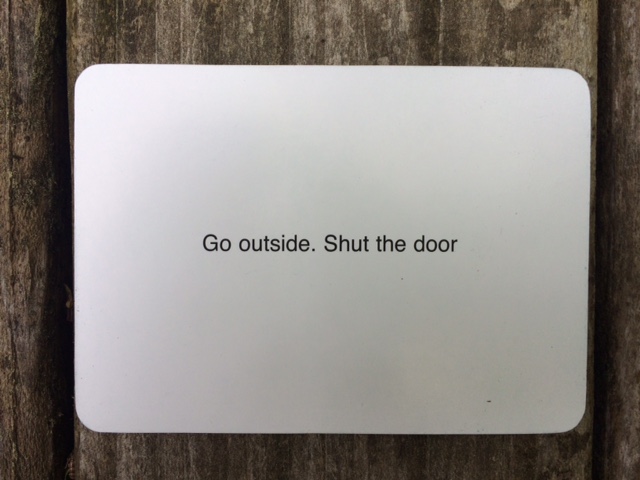
Basically, if you’re working on a project and find yourself stuck, or simply desire a new approach, reach for a card and do what it says. For instance, I have no idea what I am going to write about for the rest of this blog post, so I’ll pick a couple of cards to jump-start this thing. Card 1:

GoOutside

Great idea, but I’m actually one step ahead of you Oblique Strategies. I’m sitting on Kavanaugh Boulevard outside of Starbucks sipping on a black coffee and trying to write this post. I’m writing in my classic black and white composition notebook while the Funkadelic song “Can You Get to That” (aka the greatest song ever) plays from the speaker above my head. This is a great strategy. While there are different flavors of “outside”— a quiet corner of the woods would be markedly different than this relatively simulating street corner— getting outside your stuffy old work space is certainly a good idea once in a while. Card 2:

BetterJudgement

So since I am the only person currently working on this post, I suppose I am the only person I could ask to work against my better judgement. So I guess I could tell a joke I made up— that could go over poorly. Oh yeah it’s also a Jewish joke, and I’m not Jewish— yep, this sounds like a really bad idea. Let’s do it!

Q. How far can a Jew throw a Ram’s horn?

A. Shofar

So you maybe need to say that one out loud (and know what a Shofar is) to get it. Anyway, that definitely went against my better judgement. But look at that— I squeezed like 250 words out of those two cards. I’m almost done with this blog post. Thanks Oblique Strategies!

Of course, there are many other methods that musicians and artists use to figure out what to do next. John Cage used the I-Ching, David Lynch uses transcendental meditation, and countless other artists have used a lot of drugs. Some of these methods are obviously more sustainable than others, but it is clear that there is no shame in using a little outside help to get the creative juices flowing. I chose to turn to Oblique Strategies to help me create the following song.

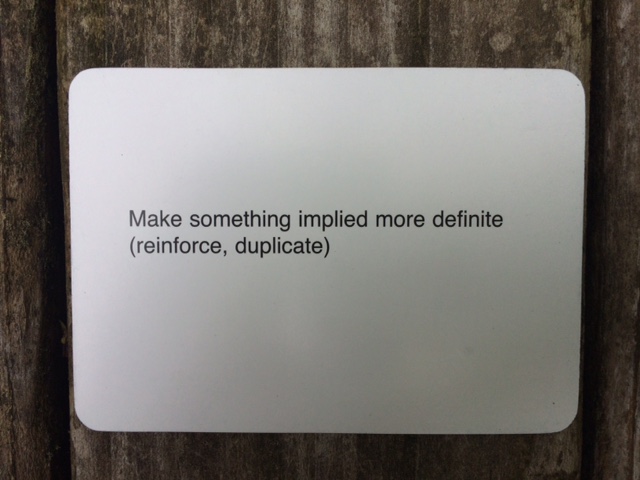
In fact I had a lot of help on this track beyond Oblique Strategies as well. As mentioned last week, the bass line was recorded by Bloomington, Indiana bass extraordinaire Brenton Carter during a jam session of ours— shout out to my man Noah McNair as well for laying down some slick keyboard lines that tragically went unrecorded during that session. Also the sax and flute parts were recorded by the great Matt Schatz, who, in the spirit of this blog post, was asked to draw an Oblique Strategies card for himself. His card read:

ImpliedDefinite

Thank you to Brian, Peter, Noah, Brenton, and Matt for all your help, and I hope everyone enjoys Opus 3.

This post is part of a nine month project in which I am releasing a new song and blog post every week. If you want to get caught up, here are the links to the previous entries:

Nine Months of New Music— Opus 1

That’s Masturbation— Opus 2

DSC00471

When I was in college at UALR, I minored in Information Technology. I learned a lot of useful stuff about web design, writing code, and creating databases (very little of which I use today). There was also a great emphasis in the program on group projects— which I hated. My arrogant belief was that I just as easily could have done these projects on my own and I’d rather not be slowed down by some dead weight classmates. In fact the most personally inspiring moments in IT class came when I was learning about web services that would allow me to get on with my life all on my own.

My dream was to write, record, release, and perform my own music, and I discovered things like TicketFly, Pond5, CD Baby, and Soundcloud which made me believe that my dream was a realistic possibility. Apps like these point to the “do-it-yourself” ethic that is the current zeitgeist in everything from music, to comedy, to fixing your toilet. I am certainly a part of this song and dance: I am a self-employed gigging musician attempting to keep a blog and record/release music all on my own.

Yet if you take do-it-yourself to mean literally doing it all on your own, then you are actually just talking about masturbation. Anything good and fun done completely alone is just masturbation. You’re cooking decadent meals, but not sharing them with anyone? That’s masturbation. You’re working on your jump-shot, but not playing in pick up games? That’s masturbation. You’re writing and recording songs but not letting anyone hear them? Masturbation. This isn’t a knock against masturbation. I think a moderate amount of literal or metaphorical masturbation is healthy, natural, and fun. But if all you are doing is masturbating, you’re missing out on the most important thing in life: connection. So don’t take do-it-yourself literally. Find some folks with similar interests and do-it-together.

You literally cannot do it alone in the field of music (or in any creative field for that matter) and expect to succeed. Your lifeblood as a musician is other people. You need other people to teach you how to play (and don’t come at me with that “self-taught” BS— if you claim to be “self-taught,” you’re just saying that instead of taking formal lessons, you learned by directly listening to other musicians); you need other musicians to play your songs; you need bar and venue owners to book your band; and most importantly, you need fans to support your work.

In addition to basic musician’s needs like these, there’s also the fact that you probably want your actual creative work to be good. If this is the case, you’ll benefit from bouncing your artistic ideas off of other creative minds. So as much as it pains me to admit it, being forced to do group projects in my IT minor program was not the worst thing. It is certainly effortful (and often a pain) to have to schedule meetings with other people, and lobby for your ideas, and come to compromises; but the purpose of group work is not to make the project quicker and easier—the purpose is to create better work than you could have on your own. John Lennon, George Harrison, and Paul McCartney all had great solo careers (sorry Ringo), yet their greatest works were made when they were working together (with Ringo) in the Beatles. Music is simply made better when other creative minds, expert ears, and skillful hands are contributing to it.

Yet I confess that none of the songs I’ve released online to date have been collaborations. This is not a point of pride—throughout the course of this project I hope and plan to release many songs that feature other musical artists. Last week I took a serendipitous step towards this end when a couple of young bass players from Bloomington, Indiana came over to my house. My college buddy Noah McNair and his friend Brenton Carter were in town to play with the Arkansas Symphony Orchestra and they popped over to my house during the day to jam. I’ll forgive them for forgetting the beer, because I roped them into helping me record a song of mine. We started jamming on a song that I had written and I decided to hit record. After they departed the song was left with a much better bass line than I could have possibly played, recorded on a much better bass than I could hope to afford.

But you’ll have to wait until next week to hear that one (remember, I’m posting something every week for nine months). For now, here’s another one of my do-it-alone efforts. Enjoy Opus 2.

lucasguitar

I’M BACK Y’ALL! I’m back. But Lucas, where did you go? Well, if you’ve followed my internet life, as I’m sure very few of you have, you’ll remember that once upon a time I was keeping a music blog here at LucasMurrayMusic.com. That practice tapered off last summer as I got more and more busy with my life of teaching and playing music, but here I am, back again. Before I left the blogosphere (wow, that is actually a word), I documented my life of gigging, my opinions about various bands, the risks and rewards of creating something, and kept web-diaries of three separate tours (two in America, and one in Africa!). On at least two occasions, I also did something similar to or exactly like proclaiming “I’M BACK!”

You know how certain rappers (read: every rapper) will at some point exclaim in a song “I’m back,” and you the listener will wonder where they went in the first place to be back… Well yes, that’s essentially what I am doing as well. But I now think I understand T.I. or Eminem’s need to claim to be back. There is an inherent insecurity in artistic endeavors. First of all, there is no urgent need for you to record a rap song, or write a blog-post, or paint a picture of a snow leopard. Every artist must overcome the fact that the world will keep spinning without their art. This in mind, the artist can feel like he or she must continually justify his or her work. Furthermore, if there is any time interval between works of art (which inevitably there will be), an artist might feel that he or she has become irrelevant (granted, it’s closer to the truth in my case to say that the artist was never relevant in the first place). Thus, one oft used defense mechanism is to bust through the wall Kool-Aid Man style and scream “I’M BACK!”

Anyway, I’m back, and I have a new plan: I will release one new song and one new blog post every week for nine months. That’s right, one full human gestation period. This is the first full week of April, and so my target end date is the last full week in December, specifically my birthday, December 30th (side-note: I just accidentally figured out when I was conceived).

But seriously Lucas? One new song and one new blog-post every week? Isn’t that a little ambitious?

Yes it is, skeptical inner voice, but only if you expect all of these posts and songs to be good. Frankly, they’re not all going to be good. I’m going for quantity, not quality. Yet I’m doing this in good faith that if I produce a bunch of work, some of that work will actually happen to be good.

There’s an anecdote I often repeat to people from the excellent book Art and Fear by David Bayles and Ted Orland that illustrates the logic behind my new project. In brief, a college pottery instructor at the beginning of the semester informed half of her class that they would be graded on the quantity of pots they make, and she told the other half of her class that they would be graded on the quality of a single pot. Thus, all semester long the students in the quantity group were just uncritically churning out pot after pot after pot, while those in the quality group were paying precise attention to every detail of their pots. Predictably, at the end of the semester, the quality group’s pots were mostly good—some of them very good— while the quantity group’s pots ranged from very bad to very good. What may come as a surprise however, is that the very best pots in the class were all made by students in the quantity group.

This points to a crucial point about learning to make art: that if you wish to produce your best work, you don’t necessarily need to slave away worrying about every detail on a single work, you must simply create and create and create, and some of your art will be really good. Don’t worry about making bad work. Some of it will certainly suck. The shitty stuff is simply fertilizer for the flowering of great works.

Thus, in the spirit of producing work, here is Opus 1 (look below). I actually wrote and recorded this song when I was 19, and at the time believed it to be the best song I had ever written. I’ve certainly grown and changed since then, but I am releasing it now because I never really let it reach any ears beyond a handful of friends and family. Furthermore, the song also captures a yearning for something that I believe I am attaining in the pursuit of this project. Enjoy.

(Note: “Opus” is simply the Latin word for “work.” Composers have been using the word since the fifteenth century, often to number their compositions in chronological order. For this project I too will use this convention. Some songs may have subtitles, but every one will have an opus number.)

https://soundcloud.com/lucasmurray/opus-1-ghost-life

swampfun

I just spent a week and a half on the road with the band Swampbird. All the new people and places were so stimulating and fun that I completely and unashamedly abandoned my attempt at keeping an online tour diary (although at one point that seemed a promising endeavor). I haven’t wanted to analyze the trip because I’ve been completely immersed in it. So instead of trying to recreate a tour diary from memory (and a sleep-deprived, partied-out memory at that), I’d like to use what I’ve learned and experienced on tour to try to answer a question that might be on your mind: Is Swampbird for real?

The band certainly has its detractors who would say “no.” I’ve talked to people who view the band solely as a group of self-aware liberal art school graduates who put on a campy southern shtick and sing about cliché country experiences they’ve never actually had. Truly, Zac Hale has never “shot [a man] for a mean look in his eye.” While singers and bands stretch the truth or write completely fictional songs all the time, I think Swampbird gets criticized because their fictions seem so far-fetched from who they are as people offstage. Yet this criticism is only valid if you think Swampbird is trying to be serious. So the question remains: Is Swampbird for real?

If you asked the band this question at their very first band-practice in the fall of 2010 at Hendrix College, they too would have said “no.” They’ve expressed to me multiple times that at first they really just used the band as an excuse to drink whiskey and party. Their very first songs (like the song “Bottle”, quoted above), were silly caricatures of the country-western style. They were just having fun playing music, cracking each other up, and performing at house parties. The problem is, when you try to write a caricature of a country-western song, you end up sounding a lot like a country-western song. The other problem is, the Swampbird boys are actually talented musicians and thoughtful songwriters. Thus, even though they were not exactly “serious” about the band, they consistently entertained both themselves and their audiences with their performances and Swampbird gained enough momentum to continue past the band members’ college life.

Flash forward to 2015 and Swampbird is still having fun playing music and cracking each other up, but they have clearly upped the ante. They still perform the freewheeling Hendrix-era classics like “Bottle” and “1,2,3,” but now accompany them with poignant and nuanced autobiographical numbers like “Ally’s Song” and “Brussels.” As the songs have matured, so have the venues. Though I’m positive they’d still enjoy rocking a house party, Swampbird now performs on major stages both in Arkansas and around the country. They’ve even filmed multiple professional music videos, one of which (Matter of Time) has over 10,000 Youtube views. Swampbird has left the swamp.

Despite all of this, I admit that I too wondered if these guys were actually serious about music, or merely using it as a fun drinking game. Regardless, I agreed to go on tour with them because I wanted to see some exciting new places, because I knew I would enjoy playing their songs, and because I like all of the band members as people. But like the beginning of all of my good relationships—playing in bands is a lot like dating by the way, but that’s for another blog post— I was just looking to have a casual good time and ended up connecting in a much deeper way. From Alabama to Maine, Swampbird showed me an amazing good time and won me over both musically and personally.

The tone of the tour was set on our drive to Birmingham. Dylan, who is currently in Canada, homeless and recording an album with Daniel Romano (aka living his dream), needed to call to cancel his electricity at his former apartment. Discovering he had a refund check in store from his initial deposit, he asked Zac if he could have it sent to his house and then asked the customer service operator if he could put it in the care of his friend. All parties agreed. When she asked Dylan for the name of his friend he had a moment of inspiration: “yes it’s first name Za, that’s Z, A.” spoken calmly “and last name Kale, like the leaf.” Forever after on tour Zac Hale was referred to as Za Kale, most often in a Jamaican accent. From “Wawawawawawawawa,” to “praise him” to “can you feel it” to “take me home tonight,” the inside jokes amassed on tour and the laughs came easy. Our second to last show was at a brewery in Portland, Maine on a beautiful sunny, temperate afternoon. The combination of an emotional tour, sleep deprivation, chemical enhancement, and cowboy music had us compulsively laughing onstage both between and during songs— it was great.

Indeed I’ve learned that the best way to approach Swampbird is with a touch of humor— they do. Honestly I laugh every time I hear the opening line to their song Gasoline: “Momma I quit talkin’ to Jesus, but I’m too ashamed to let you know, I put my faith in this goddamn rodeo.” From talking to him I understand that this is actually pointing to a real sorrowful feeling and experience in Dylan’s life, but this line is delivered in such an over the top classic-country way, that it is always funny to me. Swampbird intentionally exists in this grey area between humor and heartbreak and I think this is a brilliant element of the band— you can choose to either laugh or cry within the same song. This is nothing new; from it’s earliest incarnations, country music has always walked this line. Just ask Hank Williams. Yet Swampbird’s playful and sometimes irreverent attitude is perhaps what rubs some listeners the wrong way and leads them to question the band’s sincerity. I believe that they are simply following in the footsteps of innumerable self-aware country artists who weave between irony, obscenity, and honesty (e.g. Kris Kristopherson, David Allan Coe, Drive-by Truckers, etc.).

Not everyone will appreciate Swampbird’s lyrics— this is fine (I’ve written before that it is better to be loved by some and hated by others than kinda-sorta liked by all). Yet if you listen to more than the words, you’ll notice that Swampbird does some very interesting things with the musical elements of their songs. None of the band-members are classically trained, but they use what they know about music in very clever ways. Going from loud to soft (and vice-versa) is something that everyone innately understands and responds to, yet many young bands totally disregard this effect and very few bands I know utilize dynamic volume as well as Swampbird. Furthermore, most bands overall play far too loud and drown themselves out— Swampbird doesn’t necessarily play soft, but stays low enough for every part to be heard coherently. Harmonically the band isn’t reinventing the wheel, but they are not writing the same I-IV-V chord songs that everyone and their mom has already written. They often use familiar chords and progressions, making their songs easy to listen to and understand, but vary them enough to keep both the audience and the musicians entertained. I’d like to pull out my music major/gigging guitarist credibility card and tell you to trust me when I say that Swampbird writes musically rich songs. They also build in moments of improvisation into most songs so that live performances are not merely cookie cutter renditions of their album recordings, but spontaneous and unique moments. I took full advantage of this fact and flexed my improv muscle at every gig we played on tour (Zac and Dylan delightfully laughed at me for never playing the same thing twice). I had so much fun playing these songs.

In addition to their song structures, Swampbird also handles the logistics of band management with great organization and planning. Dylan did a wonderful job of booking this tour, asking other bands and artists about each venue, and making sure travel lengths and lodging plans were all feasible. Additionally Zac operated as band treasurer during the tour, keeping tight records of all of our income and expenses (he also did a wonderful job calling and researching rental cars for the ride home). Pete Campos operated as band manager/free-safety, taking care of our payments, selling merchandise, driving the van, and selflessly letting us have the best sleeping spots wherever we stayed. Paul and I pretty much just played drums and guitar. Additionally when faced with difficulties, the band was never too flustered, but handled it with reason and direct solutions. In Boston, we stayed at the house of Dylan and Zac’s larger than life college buddy Conner (affectionately known as “Corn-dog”). We all stayed up far too late drinking and telling stories, and in the morning Dylan and Conner were abruptly awoken by Conner’s roommate: “Conner! You gotta go to work, you’re late! … Oh, dude, your van’s getting towed.” Dylan ran outside just in time to see the van getting pulled away. Dylan went back inside, slept another hour, found the place it was impounded, walked all the way there, paid for the van, and returned to pick us up.Naturally he was a bit surly about the whole ordeal, but simply solved the problem without even waking us up.

Yet the true measure of a band’s viability is not in its organization, songwriting, or attitude, but in the way it relates to people. Fans are a band’s life-blood. From my very first Swampbird show, July 27 at The Whitewater Tavern in which dozens of people were singing along to the swamp songs, I’ve been pleasantly surprised by how well people respond to this band live. Excluding Knoxville (Knoxville was a bummer except for all the money and pizza the venue gave us— thanks Barley’s), we either played to current fans or won new fans everywhere we went. Our last performance of the tour was an impromptu outdoor show literally on the sidewalk of downtown Portland, Maine in the middle of the afternoon. We had a few friends come listen and Paul had some family there supporting him, yet the majority of the audience members were simply passersby who decided to stick around. No one is going to get rich playing on the side of the road, yet the street is the oldest stage in the world, and perhaps the truest test of your appeal as an artist. There was no reason for anyone to stay and hear us play— if anything there was reason for them not to stay, assuming they were on their way to some other location— yet we won them over merely by merit of our sound (well, perhaps our look as well, but whatever it takes).

So, is Swampbird for real? Undoubtedly, yes. They are playing major shows, going on national tours, recording and selling albums, filming widely seen music videos, getting great press, and writing good music. Yet this doesn’t mean that they take it all too seriously. They still like to laugh, party, and hangout and during live performances you can tell that they are enjoying themselves. Personally, I find their attitude refreshing. Too many artists are completely humorless about their art. Certainly art can approach any subject, and certain tragic topics deserve to be handled solemnly, yet ultimately the act of creating art is obscure, ineffable, and useless. I appreciate Swampbird for having fun with it.

Swampbirdsellick

Big thanks to Nick, Morgan, Conner, Tim, and the Mallet Brothers Band for giving us places to stay and showing us the time of our life!

EasternPromises1

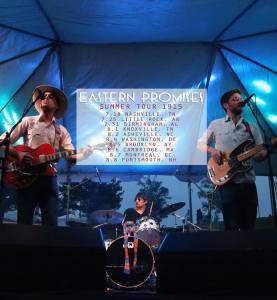
Last month Trent Whitehead, lead guitarist of the rambunctious alt-country outfit Swampbird, abruptly sent me a facebook message asking if I wanted to fill in for him on Swampbird’s East Coast tour (Trent couldn’t get away from work for the necessary two weeks). Though I had never played with the band before, I knew from previously seeing their energetic shows and meeting all the band-mates that it would be a fun time. I said yes. After confirming it with me, Trent asked his bandmates Dylan Vernon (guitar, vocals), Zac Hale (bass, vocals), and Paul Fennig (drums) if it would be ok if I substituted for him. They said yes.

There is a symbiotic relationship between myself and the band. I play lead guitar, filling out their sound, and they take me around the country, letting me continue to live out my dream of traveling and playing music (if you ask me I think I’m getting the better end of this deal). I certainly hope Swampbird continues to grow and have great success, and I hope I can contribute to that success while I’m on tour with them, but because I’m not actually in the band, I also have a close eye on how this tour is benefiting me personally and musically. Namely, I am getting to witness and sample other music scenes around nation (I may want to move to one of these places someday) and practice playing a country-rock guitar style that I don’t often get to perform. I am thankful and humbled that they’ve agreed to bring me along and am looking forward to the wonderful highs and lows of life on the road.

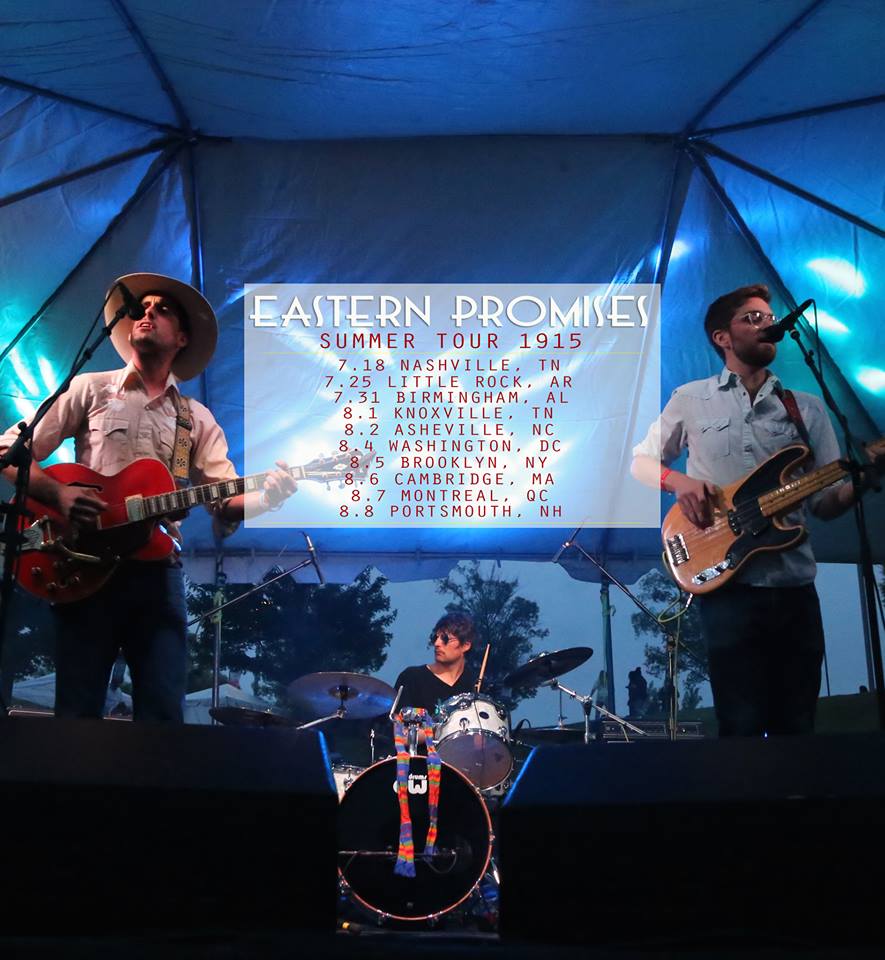
Though late nights and ample adult beverages will surely threaten my productivity, I aim to keep a consistent tour diary as we travel to some really cool places:

7/31— Birmingham, AL | Secret Stages Festival

8/1 — Knoxville, TN | Barley’s

8/2 — Asheville, NC | Jack of the Wood

8/4 — Washington, DC | Hill Country

8/5 — Brooklyn, NY | Bar Matchless

8/6 — Cambridge, MA | Middle East

8/8 — Portsmouth, NH | The Press Room

Friday July 31st, 2015. Day one.

We met at 10:00am to pack up the tour van at Dylan’s downtown Little Rock apartment. There I met the fifth Swampbird Pete Campos, a self-described “cog in the machine” for Sticky’z and Rev Room in Little Rock. He’ll be handling the driving, merchandise-dealing, and kitten herding for the duration of the tour. We were on the road to Birmingham by 11am. The spirits were high, and the jokes were base. I was happy to be on the road again.

Our soundtrack for the first leg of the journey was Canada based singer/songwriter Daniel Romano. Romano’s songs are all about heartache and call to mind singers like Faron Young and Merle Haggard. Though he has an absolutely classic-country sound, Romano feels that most of the artists we refer to as “country” today have strayed from the genre’s roots. Thus Romano has coined a new term to describe his genre: Mosey. It’s great driving music.

Dylan was already a huge fan when he heard that Daniel Romano was playing a show at J.R.’s and needed an opener— he quickly assembled a band to play the show, mainly so he could hear and meet his idol. Months later, Dylan was looking at Romano’s tour schedule and noticed a two day gap between his shows in Shreveport and Nashville. He contacted Romano’s manager Kay Berkell and asked if they wanted to do a show in Little Rock with Swampbird. She exclaimed that they had in fact been trying to book a show in Little Rock and would love to. More meetings and correspondence followed and culminated in Kay asking Dylan if he wanted to record an album of his own originals with Daniel at his Ontario studio. After Dylan checked multiple times to see if she was actually serious and not just being nice, she insisted that she was and said they would be free to start it August 9th, the day after Swampbird’s last show of the tour in Portsmouth, New Hampshire. Thus, after we wrap up the tour, Pete, Paul, Zac, and I will rent a car and travel home to Arkansas and Dylan will drive the van to Ridgeville, Ontario to cut an album with his musical hero.

I am naturally the outsider in Swampbird (having spent only a handful of days around them), so I enjoy getting stories on the background and futures of my momentary bandmates. Although the band currently resides in Little Rock, it turns out that all of the members are transplants. Dylan is originally from Lake Charles, Louisiana but moved to Arkansas in 2005 after Hurricane Katrina. He finished up high school at Subiaco Academy and then attended Hendrix for college. Zac grew up in Huntsville, AL and chose Hendrix because it gave him a nice scholarship. Dylan, Zac, and Trent met at Hendrix and quickly began to hangout and play music with each other. Though, the band was at first just “an excuse to drink whiskey on weekdays,” by the end of college it was a musically viable entity and they decided to pursue it in Little Rock. Paul is originally from Des Arc, AR but moved to Little Rock in 2003 after finishing college at Lyon in Batesville. He had been in numerous Little Rock bands such as Frown Pow’r, The Modedz, Tsar Bomba, The Yips, and Life Size Pizza by the time The Swampbird dudes were in need of a new drummer. He joined them in 2012 and his first gig with the band was at Riverfest that same year.

We rolled into Birmingham around 6pm, set to play at a German restaurant and bar called Das Haus as part of the Secret Stages festival. We met a kindly artist and festival worker named Soso who clued us in to the location of the Secret Stages VIP room where we could have our fill of food and drinks. After satiating ourselves with delicious Tacos and local beer, we loaded in our equipment and prepared to play the first show of tour (and my first real show with the band). I comforted myself by using a cheat sheet taped to the back of my guitar to remind me of all the songs, chords, and keys. We played well, and the crowd was extremely supportive. Our 45 minute set blew by in no time because we were having so much fun.

In fact, the fun continued until well after our set. Still riding the high of the performance, we bounced between the VIP room and the various stages to check out the other bands. Secret Stages is not an outdoor festival— it exists within about a square mile area of downtown, and all the shows are at actual music venues in the area (Parthenon, Rogue Tavern, Pale Eddie’s, M-Lounge, Lobotomix, Easy Street, Das Haus). Quality control at the festival was extremely high— I didn’t see a single band I didn’t enjoy, and a couple of them truly blew me away. A band called Twin Limb performed immediately after us at Das Haus and had a lot going for them: 1. The Look— the band consisted of two pretty girls and dude who looked like a caveman from the future. They arranged themselves on stage with the girls sitting facing each other at the front of the stage and the dude standing in the back, forming a radical triangle. 2. The Instrumentation — The girls played drums and accordion and both sang, while the future-man in the back played guitar and electronic-sample sounds. 3. The Sound — despite being just a three-piece the sound was large and rapturous with beautiful vocal melodies ringing out over big beats and heavily effected guitar and accordion.

After the Twin Limb show, Lacy, the accordion player/singer in the band, recommended we check out their friend’s band called Landlady. Pete confirmed that Landlady was definitely a worthwhile show, but before we could do that, we needed a refill at the VIP station. Two hilarious things happened there. First, Paul discovered an unwrapped (yet hopefully unused) condom in the diet coke cooler and very politely informed one of the festival volunteers of the situation. Second, Dylan, while chatting up a local PYT, knocked over a large precariously built display of all the Secret Stages bands arranged like the periodic table with the brim of his cowboy hat. It seemed an accident waiting to happen, but he profusely apologized to the staff to prove he wasn’t a complete drunk idiot.

After the VIP room shenanigans, Dylan and Zac went to see an interactive psychedelic band called Space Face while Pete, Paul, and I went to check out Landlady. I really can’t remember the last time I was so swept away by a musical performance. The lead singer/keyboard player was a short guy, with a huge voice who bore a striking resemblance to Rod Serling. He was supported by a bass player, guitarist, and two drummers who traded turns playing drums and auxiliary percussion— all were extremely proficient on their instruments and provided backup vocals as well. The songs shifted seamlessly between composed, precisely executed sections and free-for all percussive freakouts. Many bands are talented but not very original. Many other bands are original but not very talented. Landlady was both— the songs were intricate, difficult, and unique, and they executed them flawlessly. I recommend them.

After the shows we reluctantly regrouped at the van and drove to Zac’s high school friend Nick’s house to crash. Exhausted, I laid my sleeping bag on the floor and passed out, while Dylan, Zac, and Nick talked, drank, and reminisced into the wee hours.

Saturday August 1st, 2015. Day Two.

We woke around 11am, still groggy from the night before, but the promise of free lunch got us on our feet and moving. Another of Zac’s childhood friends named Rachel invited us over to her house for BLT’s and delicious homemade cookies. She and her husband are sponsors of Secret Stages and enjoyed hosting bands as they travelled through. It was a big happy lunch with two bands and family members all eating and talking. We filled up to our heart’s content and then hit the road to Knoxville.

On the road we entertained ourselves by sharing shameful and hilarious high-school stories. These I can’t print, but suffice it to say that Zac Hale was a rockstar long before he was in Swampbird and I know the whole band a lot better now.

We pulled in to Knoxville with plenty of time to load in our equipment, explore a music shop next door, and kick a soccer ball around before showtime. We played at a pizza restaurant & bar called Barley’s, and unfortunately the people seemed more into the pizza and beer than our music. It was a nearly polar opposite crowd reaction than the previous night in Birmingham. We chugged along through our set, but it was difficult to not feel deflated by the crowd’s apathy. We regrouped after our first set and agreed that we should just be playing for each other and not for the indifferent crowd. We started off our second set of music with some of Dylan’s solo material that he’ll be recording later this month. I sat in with him, filling in the spaces between his words with little melodies and chords, and all of a sudden we began to have fun playing. Paul then joined us on stage, providing a nice back-beat for the songs, and by the time Zac got up there I think we felt like a whole new band. Our second set was very strong even though the crowd never really came around. We comforted ourselves with the thought of the nice guarantee we were promised by the venue and the five pizzas they cooked us (eat your heart out Maxine’s).

After the show we drove through a surprisingly active downtown night-life scene on our way to our Marriott Hotel. Pete has the hookup on the Marriott’s family rate, so we can sleep for relatively cheap in relative comfort (five dudes in one hotel room is neither the best nor worst) once in a while on tour.

Sunday August 2nd, 2015. Day Three

I woke up early and snuck out the room to go work out and swim at the hotel’s outdoor pool area. After two days of long cramped van rides, shows, and beer drinking, my body was feeling a bit stagnant, so it felt great to run around, swim, workout, and stretch. I returned to the room as everyone was waking up and we ate cold leftover pizza for breakfast as we packed up our bags.

The drive to Asheville was short and beautiful. Though I have toured like this before, I forgot that one of the most amazing parts of the experience is watching a new city or landscape roll into view— I was reminded of this wonderful feeling as we approached the Appalachian mountains. As we drove through the hills, I texted the one person I know who lives in Asheville. Simon George is an incredible keyboard player and full-time musician living in Asheville and the brother of my good buddy and Oxford American editor Max George. I met Simon last year when he was visiting Max in Little Rock and we had a brief but entertaining jam together on acoustic guitar and Casio keyboard.

I told Simon I’d be in Asheville within the hour and he invited me to come to Burial Beer Co. where Simon’s jazz-fusion trio was playing until 4pm. I suggested it to the Swampbirds, and they all agreed. I greeted Simon and he invited me to join the band for a song on the condition that I play him a solo classical guitar piece first. So I took the stage after their set break and serenaded the beer drinkers with some Carcassi etudes played on a Telecaster guitar. Next Simon and his drummer joined me and we played a jazz-funk tune called Red Baron. It felt musically nourishing to get to dip into my jazz style for a moment during this country-rock tourgasm. I do love to play with Swampbird, yet I’ve incorporated a lot of different style into my musical life (Classical, Jazz, Funk, Soul, Hip-Hop, Country, Rock, R&B) and I am left wanting if I am away from any one style for too long. I reluctantly passed the guitar back to its owner. After they finished the set we bid Simon and his mates a fond farewell and they gave us a tip about a good spot to swim in the nearby French Broad river.

Pete and Paul then went to guitar center to buy some drum gear, while Dylan, Zac, and I went for a refreshing swim. We checked in to the Springhill Suites hotel (another chain in the Marriott family where we get the good discount), and were pleasantly surprised by a large room with two full-sized beds and a massive fold out couch. I took a quick soak in the hot tub (it was a rather leisurely day), and then showered and got ready for the show.

We played at a charming little spot in downtown Asheville called Jack of the Wood. Though we were again playing at a bar/restaurant, the Asheville experience was completely different from the dead night in Knoxville. For one, Dylan and Zac had some friends come and show a lot of vocal support throughout the whole show which was very energizing. Yet many of the people who had never even heard us before payed close attention and enjoyed the show. Despite playing only for tips, we ended up making plenty of money to get us to our next stop of Washington DC. Even more satisfying was the fact that many of the audience members came up and paid us compliments. I had heard a lot of good things from artists and musicians about Asheville before visiting, and based on my brief experience it does seem to be a wonderfully supportive community for anyone pursing art. I think I’ll be back.

After the show we drove back to the hotel where we took full advantage of the fact that we did not have a show the next day. We stayed up into the wee hours talking, drinking, joking, and sending out world-class snap-chats. Some things shouldn’t be written about here, and those are the things you should ask us about in person.

By the way, if you want to follow all of the action during our tour, the best way to do that is to add us on Snapchat (if you don’t have it, get it) at SwampbirdTV. The snaps are golden.

LucasGuitar

For the past seven years I’ve been living a double life. On the outside, I’ve appeared to be a dutiful college student, guitar teacher, and performer— learning, teaching, and playing music that others have written. I’ve played with numerous original music groups along the way (Ezra lbs, The See, Velvet Kente, Rouxster, Big Piph & Tomorrow Maybe), but I was never the primary creative force in any of these bands, merely the guitarist. My dirty little secret is that I’ve been writing my own music and lyrics since high school. I have numerous reasons for hiding this shameful activity: it’s egotistical, it doesn’t make money, there are a million better songs, I don’t want people to dislike my art (or dislike me for producing it), and my songs are never as good as I want them to be. Yet I realize that I am not going to stop writing songs anytime soon— truthfully, writing, recording, and performing original music is my most pressing desire. I could continue to conceal my creations, but I would be cheating both myself and any potential listeners. Thus, I’d like to refute my reasons for not releasing my work and then share two Indie Pop-Rock songs I’ve recorded this year.

It’s egotistical. Of course it’s egotistical. My lyrical content is all about my life. I’m writing all about my personal hopes, heartbreaks, connections, and philosophy because that is what I know best and what carries emotional weight for me. Furthermore, the act of writing anything to be shared with others is always at least partially egotistical. Whether it is in this blog or the music I write, there is a consistent voice behind the overt content that simply says “hey listen to at me! I have something important to say.” This is fine. I don’t think I want to hear an egoless song because I wouldn’t believe it were authentic— perhaps a small number of spiritually enlightened people have learned to live without ego, but 99% of the world has not. Furthermore, without ego you don’t have the feelings of desire, ecstasy, vengeance, lust, frustration, confusion, depression and triumph that tend to make for a good song. To quote the late writer and instructor William Zinsser, “writing is an act of ego, and you might as well admit it. Use it’s power to keep yourself going.”

It doesn’t make any money. Truthfully this is a big reason that I do not spend more time creating and sharing my work. I teach and perform other people’s material because that is what people pay me to do. If I were paid handsomely to write and record songs then I would do it all the time. Yet even in the absence of payment, I do find time to create original music and yearn to do it even more often. This is because I don’t see the art of music as merely a means to a payday, but experience it as a way to explore and release my desires and emotions and ultimately satisfy my basic human need to be creative. There may even be benefit in not getting paid for my art (said the guy not getting paid for his art). If I needed to make money writing songs, then I would need those songs to appeal to whoever were buying them— all of a sudden my freedom to express myself would be narrowed by the need to appeal to my buyers and my songs could become watered-down and emotionally ineffectual. On the contrary, right now I can write and record literally anything I want (be it sad, experimental, obnoxious, long-winded, sloppy, offensive, etc…) and I think that often the best art is produced in this space of ultimate creative sovereignty. Yet I would be lying if I said I didn’t want to make money on my music. I do, and even use this desire as motivation to create. For although I currently get paid more to teach and perform than to create, in the long-term I know that it is original music that could make me the most money (through record sales, commercial licensing, movie soundtracks, etc…). In short, no my original music doesn’t make me money right now, and I don’t need it to for it to be a satisfying personal activity, but I do want it to.

There are a million better songs. Sure there are. But there are a billion worse songs as well. I don’t necessarily benefit from turning songwriting into a competition, but I do listen to a lot of music, and I do often think “I could write a better song than that.” Even more often I think “that’s offensively unoriginal.” In the least I know that I have a unique perspective and a unique voice (I think everyone does if they are honest with themselves) and I am going to try to express it in my songs because no one else will for me. Ultimately it doesn’t really matter if these are better or worse than any other songs— they are different, they are mine.

I don’t want people to dislike my art. This is my biggest hindrance to actually sharing my work. I admire people who seem to not care what others think of them, but by my nature, I can’t help but care — I really want people to like me. When someone listens to something so personal as a song I’ve written, it’s easy to feel like their judgement of it (whether good or bad) is a judgement of me as a person. My mom, a terrific realist painter, once gave me an empowering book called Art and Fear by David Bayles and Ted Orland; amongst many other “observations on the perils and rewards of art-making,” they addressed the need to detach yourself from your work. You are not your art. Your personal value, strength, and identity as a human doesn’t come from any particular symphony you’ve composed, still-life you’ve painted, or nude you’ve sculpted. Certainly during the fervor of creation you can become one with the piece, yet as soon as you share it with the world, it has a life of its own— people will view it, share it, judge it and interpret it through their own personal filters. You too will change, grow, and create new work, so there is no use in identifying yourself with a piece that is no longer representative of what you are. Thousands of people could love or hate your art, but it is up to you to love yourself and keep creating. Finally, the goal of creating art shouldn’t be to make something that everyone will like. Musicians who have tried to appeal to everyone have ended up making middle-of-the-road elevator music. It is better for some to love your work and some to hate it, than to have everyone kinda-sorta like it.

My songs are never as good as I want them to be. I could talk about this phenomena myself, but someone smarter and more experienced than me has already said everything I want to say about the matter. Enter Ira Glass: “Nobody tells this to people who are beginners, I wish someone told me. All of us who do creative work, we get into it because we have good taste. But there is this gap. For the first couple years you make stuff, it’s just not that good. It’s trying to be good, it has potential, but it’s not. But your taste, the thing that got you into the game, is still killer. And your taste is why your work disappoints you. A lot of people never get past this phase, they quit. Most people I know who do interesting, creative work went through years of this. We know our work doesn’t have this special thing that we want it to have. We all go through this. And if you are just starting out or you are still in this phase, you gotta know its normal and the most important thing you can do is do a lot of work. Put yourself on a deadline so that every week you will finish one story. It is only by going through a volume of work that you will close that gap, and your work will be as good as your ambitions. And I took longer to figure out how to do this than anyone I’ve ever met. It’s gonna take awhile. It’s normal to take awhile. You’ve just gotta fight your way through.”

And so in the spirit of closing the gap between my killer taste and my amateur output, I’m going to share two songs I’ve recently recorded. In truth these are only rough drafts. I recorded these songsall on my own and I know they can be improved by professional mixing/mastering and live drums (although my sampled drum tracks are pretty charming I think). My plan is to record an album’s worth of songs on my own (which allows me to flesh out all of the parts) and then re-record them with my friends Daniel Olah (drums) and Brad Birge (bass) at Jason Tedford’s Wolfman Studios (none of them know this yet by the way). I’m sharing them with you right now in part because I think they’re catchy and you might like them, yet also to push myself to continue to record. If people like these songs, I’ll be encouraged to record and share more; if people don’t like them, I’ll be encouraged to record more and improve. Regardless, my secret is out now, and I am going to keep recording. I have too much material that I’ve been sitting to not release it into the world. I hope you enjoy!

(lyrics below)

Jesus Burger

you wear a shirt you bought today

you sport a hat and morning shave

you get your style from magazines

and style your hair like him onscreen

you only scream when watching sports

you dream just like a sleeping corpse

you only kiss when you are drunk

your love is sinking or it’s sunk

these garish gods

they pave the way

for passive people

passing days

Jesus burger

Buddha fries

savior sugar

recognize…

you get your comfort from TV

you get your words from what you read

you eat your lunch at nearly noon

you only speak when spoken to

work all day for dollar bills

and go to sleep by eating pills

you cannot speak and so you text

you can’t make love but still need sex

these garish gods

they pave the way

for passive people

passing days

Jesus burger

Buddha fries

savior sugar

sure tastes nice

these garish gods

they pave the way

for passive people

passing days

Jesus burger

Buddha fries

savior sugar

paradise

Sweat Machine

I got nothing but time for myself

but you got something for me I can tell

pocket room but there’s nothing to sell

you got something

tell me

your secrets surely will compel me

to wear your darkness on my short-sleeve

to let me drink the blood I need

whatever you need

will only grow up from this black seed

will always be there when you breathe

will always be there when you breathe

I got nothing but time for myself

but you got something for me I can tell

pocket room but there’s nothing to sell

but you got something for me I can tell

stop now

you had another evil thought now

but we both know that it’s your heart’s vow

you signed up for this when you came down

when we came down

somehow we showed up in the same town

somehow you knew just when to spin around

and now I’m spinning with you… with you

with you with you with you with you

with you with you with you with you

with who with who with who with who

we’re through we’re through we’re through we’re through

I got nothing but time for myself

but you got something for me I can tell

pocket room but there’s nothing to sell

but you got something for me I can tell

pay no mind as I talk to myself

I’m just trying to say something else

pocket room but there’s nothing to sell

but you got something for me I can tell